All posts tagged: Calder

Who Was Alexander Calder and Why Was He So Important?

Who Was Alexander Calder and Why Was He So Important?

In 1937 Calder returned to Paris, where he set up a studio in a garage outfitted with an automotive turntable, likely to facilitate the viewing and adjusting of his sculptures. That same year, he was commissioned to create Mercury Fountain for the Spanish Pavilion at the International Exposition in Paris. The work included mercury mined in Almadén, Spain, a material that symbolized Republican resistance during the Spanish Civil War. It was shown alongside Picasso’s Guernica and Miró’s The Reaper, reflecting the political engagement of these artists. Back in New York in 1938, Calder began construction of a large studio on the foundations of an old dairy barn in Roxbury and shortly afterward converted the adjoining icehouse studio into a living space known as the “Big Room.” That same year, his first retrospective, “Calder Mobiles,” was presented at the George Walter Vincent Smith Art Gallery in Springfield, Massachusetts. The show included 61 pieces of jewelry, and among the guests at the opening were designer Alvar Aalto and painter Fernand Léger. A year later, Calder was commissioned by the Museum of Modern Art …
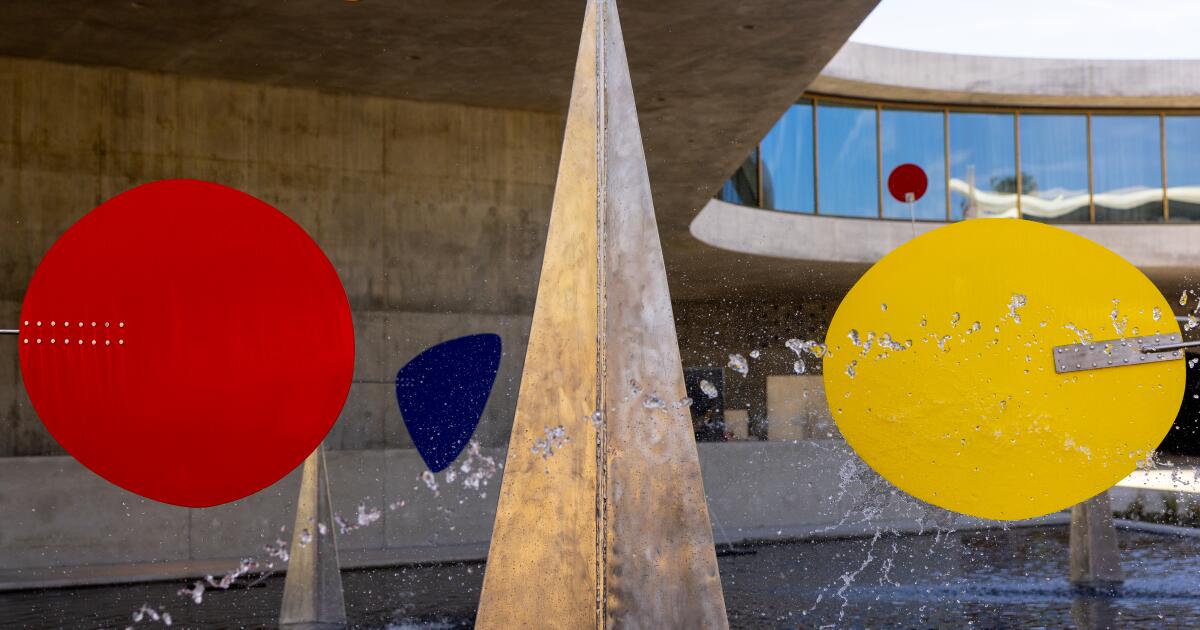
Alexander Calder fountain is back at LACMA’s David Geffen Galleries

Alexander Calder fountain is back at LACMA’s David Geffen Galleries

What’s old is new again as sculptor Alexander Calder’s monumental “Three Quintains (Hello Girls)” is installed to anchor the northeast corner of Los Angeles County Museum of Art’s new David Geffen Galleries. The four water jets that propel the colorful, whimsical sculpture were turned back on in March more than 60 years after the piece was first commissioned for the museum’s original William Pereira–designed campus, which opened in 1965. “The concept of museums commissioning artists is now commonplace. It wasn’t commonplace then,” said LACMA’s senior curator and modern art department head, Stephanie Barron, as she watched the fountain’s bright yellow, red and blue mobile-like paddles dance and twist in the wind and water, alongside Sandy Rower, Calder’s grandson and head of his foundation. Sandy Rower, sculptor Alexander Calder’s grandson and the head of the Calder Foundation, stands beside his grandfather’s 1964 fountain, “Three Quintains (Hello Girls),” which was just installed at Los Angeles County Museum of Art’s new David Geffen Galleries. (Etienne Laurent / For The Times) Not only was the sculpture, fondly referred to …

Calder Sculpture in D.C. to Be Restored a Decade After Dismantling

Calder Sculpture in D.C. to Be Restored a Decade After Dismantling

A partially dismantled sculpture by Alexander Calder in Washington, D.C. is, at long last, in the process of being restored, according to Roll Call, a publication that focuses on Capitol Hill-based news. The sculpture in question, Mountains and Clouds, fills the 90-foot-high, skylit atrium of the Hill’s Hart Senate Office Building, which was constructed in the 1970s and first occupied in 1982. Calder’s proposal was chosen from a group of five sculptors who were tasked with designing “a work that would harmonize with the atrium’s surrounding white marble architecture and yet stand apart from the cluttering distraction of adjacent doors, windows, and balconies,” according to the Senate website.  Related Articles Calder made the final adjustments to his sheet-metal maquette on November 10, 1976; he died the following day in New York City. Construction on Mountains and Clouds began a decade later, in 1986, and the monumental sculpture, made out of black-painted aircraft aluminum, was dedicated the following year. It is—or, rather, was—51 feet tall overall. In 2016, the 75-foot-wide “clouds” portion of the sculpture, which …

Yuko Mohri Wins ,000 Calder Prize

Yuko Mohri Wins $50,000 Calder Prize

Yuko Mohri, a Japanese sculptor whose assemblages of fruit and found objects are in high demand on the international art circuit, has won yet another accolade: the Calder Prize, which is awarded by the namesake artist’s foundation and comes with $50,000. Mohri had already built a long CV in her native Japan before she represented the country at the 2024 Venice Biennale. Building on installations that appeared in biennials held in Gwangju and Sydney, her Japanese Pavilion typified her maximalist practice, which often involves creating from furniture, wiring, piping, lights, instruments, food, and more that are hooked together. Often, these installations produce sound. Related Articles Her Venice pavilion was among the most widely praised national presentations of that year and appears to have begat an array of international museum shows, including one held last year at the Pirelli HangarBicocca in Milan. That exhibition, her largest to date, is due to travel to the Centro Botín in March. She is also set to have shows at the Bass museum in Miami and the Barbican Centre in …