All posts tagged: Classical

Hear Classical Music Composed by Friedrich Nietzsche

Hear Classical Music Composed by Friedrich Nietzsche

A philoso­pher per­haps more wide­ly known for his prodi­gious mus­tache than for the vari­eties of his thought, Friedrich Niet­zsche often seems to be mis­read more than read. Even some­one like Michel Fou­cault could gloss over a cru­cial fact about Nietzsche’s body of work: Fou­cault remarked in an unpub­lished inter­view that Nietzsche’s “won­der­ful ideas” were “used by the Nazi Par­ty.” But that use, he neglect­ed to men­tion, came about through a scheme hatched by Nietzsche’s sis­ter, after his men­tal col­lapse and death, to edit, change, and oth­er­wise manip­u­late the thinker’s work in a way The Tele­graph deemed “crim­i­nal.” Fou­cault may not have known the full con­text, but Niet­zsche had about as much sym­pa­thy for fas­cism as he did for Christianity—both rea­sons for his break with com­pos­er Richard Wag­n­er. What Niet­zsche loved most was music. Even in the wake of this scan­dal, with Niet­zsche ful­ly reha­bil­i­tat­ed at the schol­ar­ly lev­el at least, the philoso­pher is gen­er­al­ly read piece­meal, used to prop up some ide­ol­o­gy or crit­i­cal the­o­ry or anoth­er, a ten­den­cy his anti-sys­tem­at­ic, apho­ris­tic work inspires. A more …

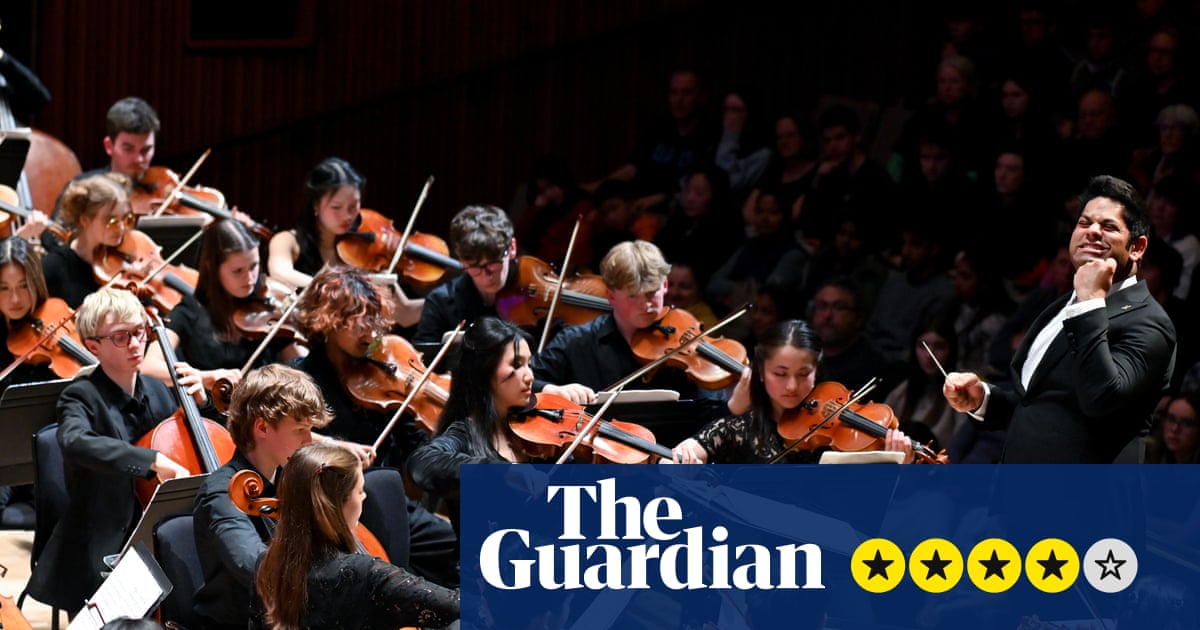
National Youth Orchestra/ Chauhan: Collide review – surging energy and remarkable intensity | Classical music

National Youth Orchestra/ Chauhan: Collide review – surging energy and remarkable intensity | Classical music

There’s always more at an NYO concert. More players: 160 this time, crammed on to a platform that seems full with half that number. More of the energy that comes with the fact that, for every player, this is a very special occasion. And, in recent seasons, more stuff to remind us that these are teenagers, not hard-bitten professionals. This time there was a semi-choreographed walk-on to a mashup of Raye and Chaka Khan, with the percussion taking the lead and the assembled orchestra eventually joining in. There was a short speech from one of the players before each work – somewhere between pointing out a personal connection with the music and giving superfluous justification for its inclusion. And as an encore – sung, not played – there was Jacob Collier’s Something Heavy, with a bit more choreography. Safe to say the other orchestras conducted by Alpesh Chauhan, the NYO’s new principal conductor, don’t ask all this of their players. But often the tautness and focus of the playing exceeded what he might expect from …

Reich: The Sextets album review – Colin Currie celebrates the minimalist master’s joy of six | Classical music

Reich: The Sextets album review – Colin Currie celebrates the minimalist master’s joy of six | Classical music

The Colin Currie Group formed 20 years ago to honour Steve Reich’s 70th birthday with a performance of Drumming. This year, the great American composer turns 90, making this, the group’s fourth Reich album on Currie’s own label, a double celebration. Sextet, hailing from 1985, features two keyboardists playing piano and synthesisers alongside four percussionists on marimbas, vibraphones, bass drums, crotales, sticks and tam-tams. Shifting patterns interlock with the precision of a Swiss watch across one of the composer’s typical fast, slow, fast, slow, fast arcs. Currie’s recording flickers with subtle nuances with a naturalistic sound less closely mic’d than in Reich’s own classic accounts. Steve Reich: The Sextets album cover. Photograph: PR IMAGE In 1986’s Six Marimbas, a rescoring of 1973’s Six Pianos, Reich has two of the instruments rise and fall in volume within the canonic textures of the remaining four. Exuberant in spirit, its woody tones fall easily on the ear. Currie’s relaxed approach – he takes 22 minutes where Reich drives it home in 16 – feels enjoyably chilled. The Double …

Shostakovich: Symphonies No 2 and 5 album review – early experiment meets mature power | Classical music

Shostakovich: Symphonies No 2 and 5 album review – early experiment meets mature power | Classical music

The latest in the Shostakovich series from the BBC Philharmonic and conductor John Storgårds pairs one of the most familiar symphonies with one of the least. The Symphony No 2 was commissioned as a piece of propaganda marking the 10th anniversary of the October Revolution; in the context of the composer’s later works it feels like a curiosity, except for what it tells us about the 21-year-old Shostakovich’s glee in experimentation. It begins with several minutes of foggy strings sliding up and down in an intangible, almost pitchless way – more sound effect than music – then builds up in a perpetual motion melee, before a klaxon introduces a celebratory chorus happily singing “October, the Commune and Lenin”. It’s brightly sung here by the CBSO Chorus, exclamation marks everywhere. The artwork for Shostakovich: Symphonies No 2 and 5. The Symphony No 5, written a decade later, could be by a different composer. Storgårds doesn’t quite find the depth of darkness that some do in the first movement, but there’s power in the way he warms …

Messiah album review – Whelan takes Handel’s oratorio back to its beginnings | Classical music

Messiah album review – Whelan takes Handel’s oratorio back to its beginnings | Classical music

Every year, the Irish Baroque Orchestra and their conductor Peter Whelan bring Messiah back to Dublin, the city of its 1742 premiere. Their recording of Handel’s oratorio – the first on period instruments by an Irish ensemble – attempts to recreate the version heard at its first performance at the Fishamble Street music hall, a hot-ticket event at which such a crush was anticipated that the ladies in the audience were requested to forgo hoops in their skirts and the gentlemen to leave their swords at home. The artwork for Messiah by the Irish Baroque Orchestra. One of the attractions was the scandal-hit contralto and actor Susannah Cibber, who sang several arias including some more often sung today by other voice types: on the recording, gratifyingly, we get to hear a substantial share for Helen Charlston, her voice firm, slightly metallic and unflaggingly expressive. Also included is a less familiar duet-and-chorus version of How Beautiful Are the Feet, written for two of the countertenors from the Dublin cathedral choirs. Here and elsewhere Alexander Chance is …

The Key Ideas of the Mimamsa School of Classical Indian Philosophy

The Key Ideas of the Mimamsa School of Classical Indian Philosophy

Summary Mimamsa philosophy interprets early Vedas to define ritual duties (dharma), not to describe ultimate reality. The connection between words and their meanings is considered eternal and inherent, not based on human convention. Vedic language prescribes action and creates duties rather than simply describing the world as it is. Mimamsa’s ideas on language surprisingly resonate with the modern Western philosopher Ludwig Wittgenstein. Show more   The humble quest of Mīmāṃsā thinkers consisted in seeking the right interpretation of the early Vedas, rather than the true description of reality or salvation. This means they did not waste much time on quarreling with peers who adhered to other schools of Indian philosophy, or darśanas. Mīmāṃsā became famous for its philosophy of language, in which a word’s meaning is inherent, while the connection between words and objects is eternal. This is a direct parallel to contemporary semantic realism in the Western philosophy of language. Moreover, to determine the proper way to perform Vedic rituals, prompted Mīmāṃsā thinkers to establish a codifiable set of actions prescribed as duties that may resonate with some of the pinnacles …

The Oddly Modern Philosophy of Vaisesika, One of Classical Indian Philosophy’s Schools

The Oddly Modern Philosophy of Vaisesika, One of Classical Indian Philosophy’s Schools

  Vaiśeṣika is one of six philosophical schools or darśanas. The common denominator among all schools was the acceptance of the authority of the Vedas and the idea that true knowledge enables achieving salvation from the cycle of birth, death, and rebirth (samsara). Vaiśeṣika, however, offered a naturalistic framework, classifying entities into categories (padārthas) and positing atoms (paramāṇu) as the building blocks of matter. Although in our Western intellectual landscape we associate Democritus as the father of atomism, who paved the way for discoveries in 20th-century physics, the metaphysics of Vaiśeṣika is oddly modern. Although there is textual evidence that Democritus, as well as other Presocratic thinkers, traveled to the East, it is hard to establish direct connections.   The Invention of Vaiśeṣika: When, Where, Who? Illustration of gurus from the printed publication of the Suraj Prakash, 1884. Source: Wikimedia Commons   Vaiśeṣika takes its name from the Sanskrit word viśeṣa, meaning “particularity” or “distinction,” and referring to existing, different, innumerable, individual entities. Its central concern is how to classify and explain reality in its …

BBCNOW/Djupsjöbacka review – Tower’s Love Returns is an uncommonly appealing piece | Classical music

BBCNOW/Djupsjöbacka review – Tower’s Love Returns is an uncommonly appealing piece | Classical music

The BBC National Orchestra of Wales is marking the 250th anniversary of the US Declaration of Independence in a series of concerts, and the UK premiere of Love Returns, by the 87-year-old American composer Joan Tower, was at the centre of this programme with Finnish conductor Tomas Djupsjöbacka. Tower is best known for her Fanfare for the Uncommon Woman and, in this work, a concerto for alto saxophone, she has realised an uncommonly appealing piece. Its title relates to Tower’s use of a melody from her piano piece, Love Letter, written in memory of her late husband, as the basis for a theme and variations structure, as different from conventional concerto form as can be, evolving and gradually accelerating in tempo over its whole span of six sections. The only departure from this is in the fifth of the six: a solo saxophone cadenza, brilliantly delivered by soloist Steven Banks. His sometimes edgy, sometimes honeyed tone was wonderfully expressive throughout, whirling virtuoso passagework countered by aching lyricism, with Djupsjöbacka ensuring that Tower’s orchestral textures offered …

Hallé/Chauhan/Helseth review – Muhly paints doom with Helseth’s gleaming trumpet | Classical music

Hallé/Chauhan/Helseth review – Muhly paints doom with Helseth’s gleaming trumpet | Classical music

Audiences can be fickle. The Hallé’s latest programme featured one of the world’s most celebrated trumpeters, a UK premiere from one of the world’s most high-profile living composers, and one of this country’s most successful young conductors – yet the Bridgewater Hall yawned with empty seats. Whatever the reasons, those who decided against booking missed an exhilarating evening. It started politely enough, with the rollicking baroquery of Britten’s Courtly Dances from Gloriana. A set of Tudorbethan pastiches, these dances encourage orchestral good behaviour. But conductor Alpesh Chauhan also allowed glimpses of a harsher, modernist world outside in the viciously chirrupping winds and off-kilter repetitions of the central Morris Dance and the gleeful snaps and rattles of the closing Lavolta. A Hallé co-commission, Nico Muhly’s trumpet concerto Doom Painting was composed for Norwegian trumpeter Tine Thing Helseth and inspired by the instrument’s biblical roles. Muhly’s note on the piece points to distinct sections featuring the trumpet as a ceremonial instrument, as an expressive fixture of depictions of the apocalypse, and as a jubilant feature of the …

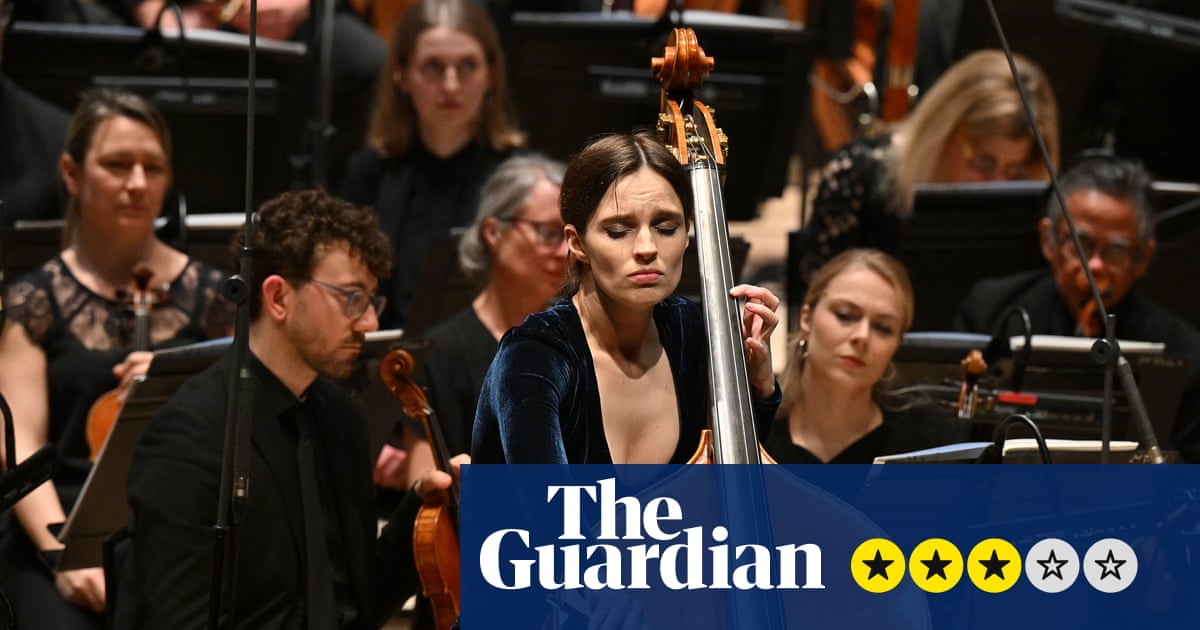
BBC Total Immersion: Icelandic Chill review – ambience, flowerpots and drones in varied day of new music | Classical music

BBC Total Immersion: Icelandic Chill review – ambience, flowerpots and drones in varied day of new music | Classical music

Despite its modest population of about 400,000 – that’s roughly the size of Bristol – Iceland punches significantly above its weight, artistically. Musicians from Víkingur Ólafsson to Björk, and composers from what has been called the First Icelandic School regularly top the bill in concert halls worldwide. But is there such a thing as an Icelandic sound? An afternoon programme of chamber and choral music suggested not. Casting its net wide, the 20th-century European mainstream was much in evidence. Hafliði Hallgrímsson’s Seven Epigrams for violin and cello, stylishly performed by Phoebe Rousochatzaki and Kosta Popovic, might have been by Schnittke. A homage to leading Soviet artists, it included a suitably jittery portrait of Shostakovich. The choral works, impeccably performed by the BBC Singers, were more idiomatically Icelandic, rooted as they were in a plainspoken Lutheranism. Anna Thorvaldsdottir’s sparse yet sonorous Hear Us in Heaven was the standout; Hjálmar H Ragnarsson’s tangy Ave Maria suggested Poulenc. More experimental works, such as Thorvaldsdottir’s quirky Sequences for bass flute, bass clarinet, baritone sax and contrabassoon, were intriguing, if …