All posts tagged: digital

At anti-Trump rally, Sánchez promises to ‘twist the arm’ of the global right – POLITICO

At anti-Trump rally, Sánchez promises to ‘twist the arm’ of the global right – POLITICO

“We will twist the arm of the people who think they are completely untouchable,” Sánchez told the crowd. “The billionaires with greed that is unlimited. Those who speculate with houses of people,” he said. He singled out oligarchs “who want to get richer using our democracy and the mental health of our youngsters.” “When we progressives reach government, it is not to serve the elites — we put them in their place,” said Sánchez. He said the far right was “organizing internationally” but insisted their numbers betrayed weakness rather than strength. “They shout not because they are winning but because they know their time is about to be over,” he said. Some 6,000 left-leaning elected officials, policy analysts and activists attended the event in Barcelona. Organizers said the gathering would conclude with a joint declaration outlining coordinated action on shared priorities including inequality, climate and digital regulation. The gathering drew an unusually broad cast of heads of state and government, including Brazilian President Luiz Inácio Lula da Silva, South Africa’s Cyril Ramaphosa and Colombian President …

The EU’s Digital Gulag Is (Apparently) Ready To Roll

The EU’s Digital Gulag Is (Apparently) Ready To Roll

Authored by Nick Corbishley via NakedCapitalism.com, “It is for parents to raise their children, and not the platforms.” Those were the words of European Commission President Ursula von der Leyen on Wednesday as she announced the readiness of the EU’s online age verification, ahem, platform. As we’ve been warning since November 2024, these platforms are ultimately a Trojan Horse for digital identity systems, which are in turn intended to serve as the cornerstone for the digital gulags being quickly assembled around the world. What gets rarely mentioned in the public debate, including in Von der Leyen’s 11-minute speech below, is the fact that online age verification inevitable traps everyone, not just minors, in its web. “Protecting the children”, however, is always a seductive pretext for launching otherwise socially unacceptable policies. And there are few more socially unacceptable policies than the controlled death of online privacy and anonymity. It is for parents to raise their children. Not platforms. The European Age Verification App is ready ↓ https://t.co/EumEPEJOI7 — Ursula von der Leyen (@vonderleyen) April 15, 2026 To save readers from having to …

Bauer cuts jobs in digital restructure amid AI search disruption

Bauer cuts jobs in digital restructure amid AI search disruption

Bauer Media Group magazine titles in the UK Europe’s largest magazine publisher Bauer Media Group will make job cuts as part of a major restructure of its digital businesses in the UK and Germany. Bauer cited the impact of Google’s AI Overviews reducing clickthroughs to publisher websites as well as “under pressure” and “fragmented” advertising models. Bauer will shut its digital business in Germany, Bauer Xcel Media Deutschland KG, on 30 September, impacting all of the division’s 160 employees. In the UK where Bauer publishes titles like Empire, Grazia and Heat, it is proposing to restructure its digital publishing businesses with jobs at risk. A consultation process has begun. Digiday reported that the cuts could affect up to 30% of all Bauer’s publishing staff. Bauer said in a statement: “In recent years, the digital publishing environment has changed significantly. Technological disruption, particularly the rapid rise of AI, is reshaping how audiences access content, with users increasingly receiving answers directly via platforms rather than visiting publisher websites. “At the same time, platform dynamics, user behaviour and …

EU eyes tougher penalties for single market rule-breakers – POLITICO

EU eyes tougher penalties for single market rule-breakers – POLITICO

Eliminating the ‘Terrible Ten’ The EU’s goal is to eliminate by March 2027 the main barriers to the EU single market — the so-called “Terrible Ten.” These include complex EU rules, overlapping national legislation and complicated business establishment laws. Brussels already launches legal proceedings against countries that obstruct trade across the single market. But these cases often drag on for years before fines are imposed. Commission officials have long encouraged quicker and more biting sanctions. In a further attempt at increasing delivery by EU countries, the EU executive plans to link payouts under its next €1.8 trillion long-term budget to executing reforms to strengthen the single market.  The document also opens the door to smaller groups of countries joining forces to push forward reforms if there is no unanimous agreement among the bloc’s 27 states.  The plan highlights simplification as the first of five pillars that member countries should work on together with the EU institutions. These will include favoring agile legislative instruments and keeping tabs on rules that are making slow progress or not …

Europe should regulate Big Tech instead of banning kids from social media, Estonia says – POLITICO

Europe should regulate Big Tech instead of banning kids from social media, Estonia says – POLITICO

Banning kids from social media won’t “actually solve the problems” and “kids will find very quickly the ways to go around and to still use social media,” the Estonian minister said. “The way to approach this, to me, is not to make kids responsible for that harm [stemming from social media platforms] and start self-regulating,” said Kallas, speaking at POLITICO’s European Pulse Forum in Barcelona. The “responsibility is on the governments and on the corporation side,” she said. “Europe pretends to be weak when it comes to big American and international corporations,” but that’s a “pretense,” Kallas said. She called on the EU to “actually take this power and start regulating the big American corporations.” Australia, the first country to implement a ban for kids having social media accounts below 15, has noted significant gaps in the way platforms implement the measures. Sonja Rijnen contributed reporting. Source link

Digital Detox: When Fertility Forums Become Compulsion

Digital Detox: When Fertility Forums Become Compulsion

For many people who go through infertility, the internet and social media can feel like a lifeline. Fertility forums, social media groups, and online communities offer something that can be hard to find elsewhere: being understood without having to explain yourself. In these spaces, you don’t have to translate medical acronyms, justify your feelings, or pretend you’re fine (when you’re not). For many, these online communities are the first place they feel truly seen. Research shows that they can ease loneliness, help make sense of grief, and offer reassurance during what is often an incredibly stressful time. In essence, it can be comforting to be able to connect anonymously on your own schedule, without fear of judgment. But there is another side to this kind of support that is rarely discussed. Over time, these same spaces that bring comfort can start to fuel anxiety, comparison, and emotional overload. What begins as connection can slowly turn into something harder to step away from. When scrolling stops being soothing Many people start by checking fertility forums looking …

Anxious young adults are more likely to develop digital addictions

Anxious young adults are more likely to develop digital addictions

Young adults who experience social anxiety might face a higher risk of developing a psychological dependence on digital networking platforms. A new study reveals that this relationship is partly explained by a psychological habit of comparing oneself to others online. The research was published in the journal Addictive Behaviors. While accessing social networks is a common daily habit, prolonged engagement can lead to a condition resembling a substance use disorder. Medical guidelines do not currently classify social media obsession as a formal mental illness, but psychologists recognize clear addictive patterns. Individuals might become excessively preoccupied with their feeds and experience an intense urge to log on throughout the day. This behavior can escalate until it regularly interferes with academic studies, career goals, and personal well-being. This pattern of digital behavior is thought to be especially common during late adolescence and the early twenties. Psychologists refer to this stage of life as emerging adulthood. During these years, individuals usually experience an increase in personal independence and focus heavily on developing their own identities. Navigating romantic and …

How the digital world is becoming more accessible. : NPR

How the digital world is becoming more accessible. : NPR

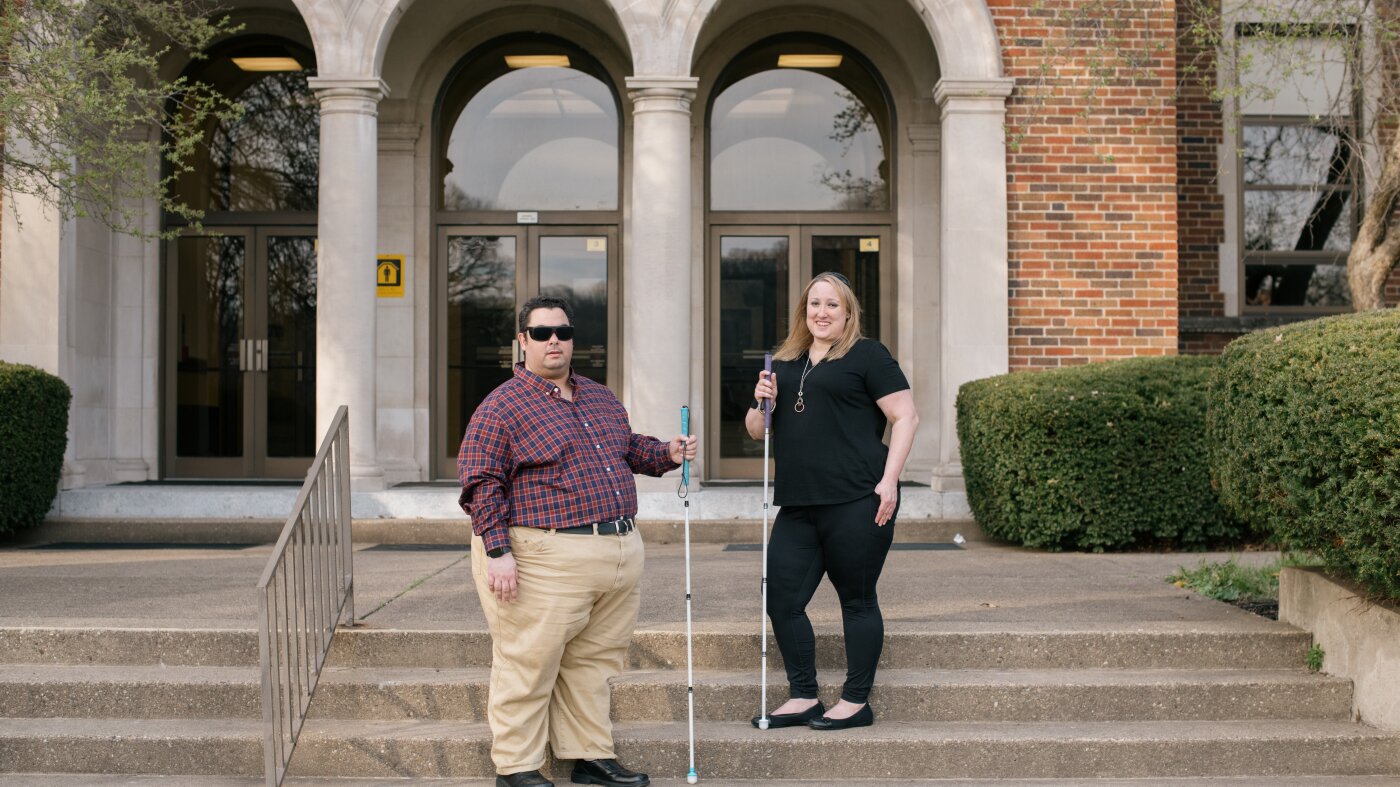
Harold Rogers and Miranda Lacy met at West Virginia State University—they both still consider this campus home. They went on to graduate school at West Virginia University, where they say they’ve faced huge challenges as blind students. Kristian Thacker for NPR hide caption toggle caption Kristian Thacker for NPR Press the “Listen” button below to hear the story text, read by reporter Jonaki Mehta. Miranda Lacy and Harold Rogers became fast friends during their undergraduate years. They both shared their dreams with one another: Rogers wanted to use his education to become a psychotherapist, Lacy a social worker. So, they were delighted to be reunited for graduate school – at an online Master’s in Social Work program at West Virginia University (WVU). Little did they know, their journey there would be much harder. Both students are blind and say learning materials, from course modules to readings for class, have been inaccessible to them at WVU. Many documents are not compatible with a screen reader, which is software that translates what’s visually represented on a webpage …

With One Million Displaced, Lebanon Turns to Digital Wallets for Aid

With One Million Displaced, Lebanon Turns to Digital Wallets for Aid

Since March, Israeli attacks on Beirut and the occupation of southern Lebanon have displaced over 1 million people. Families are sheltering with relatives, renting if they can, or sleeping in cars and out in the open, placing immense strain on already fragile infrastructure. Over 130,000 people have also crossed into Syria, many in urgent need of food, cash assistance, and shelter, according to a report by the International Organization for Migration. As humanitarian needs surge, so does the flow of money from abroad. Yet much of this support is not moving through traditional aid channels. Instead, it is being routed through digital fintech platforms to trusted individuals on the ground, who buy necessary items or distribute funds directly to the displaced. There is no real-time dataset capturing donations linked specifically to the war. However, remittances—the closest available proxy—offer context. Lebanon receives roughly $6 billion to $7 billion annually from abroad, equivalent to about a third of its GDP, according to the United Nations Development Programme (UNDP) in 2023. The UNDP reported that remittance costs there …