All posts tagged: Feminist

What Is Femgore? An Introduction to the Feminist Horror Subgenre

What Is Femgore? An Introduction to the Feminist Horror Subgenre

Horror is having a moment, and femgore is a huge part of it. But what is femgore, and why is everyone from The Guardian to Cosmopolitan talking about it? Let’s dive into this weird and wonderful horror subgenre, shall we? Femgore is a subset of what Reddit would call “weird girl literature.” But where weird girl lit is speculative fiction with a New Weird kind of bent, like Mona Awad’s Bunny, femgore leans harder into the visceral, the vile, and the upsetting. There’s often, but not always, an element of body horror. And usually, and perhaps most importantly, it’s about women and girls who are pushed to the point of violence—or who just happen to revel in it. In many ways, femgore is a response to decades of conservatism, constrained gender norms, diet culture, and good old-fashioned misogyny. These women aren’t just angry; they’re incensed. Many, like the eponymous protagonist of CJ Leede’s Maeve Fly, don’t even know where their rage is coming from. Is it the thumb of the patriarchy? Their dead-end jobs? The …

Shania Twain reveals why men are the reason she is not a feminist

Shania Twain reveals why men are the reason she is not a feminist

Stay ahead of the curve with our weekly guide to the latest trends, fashion, relationships and more Stay ahead of the curve with our weekly guide to the latest trends, fashion, relationships and more Stay ahead of the curve with our weekly guide to the latest trends, fashion, relationships and more Music icon Shania Twain has declared she does not identify as a feminist, asserting that “vulnerable men need just as much protection as vulnerable women.” The 60-year-old Canadian singer, widely celebrated for her empowering anthems such as Man! I Feel Like A Woman and That Don’t Impress Me Much, often perceived as a feminist figure. Despite her lyrics championing women and self-empowerment, Twain revealed to The Times that she finds the label challenging. “I don’t see myself as a feminist,” she stated. “I see myself as a very independent thinker and not necessarily because I’m a woman.” Twain explained the reasoning behind her surprise revelation (Getty) She acknowledged, “I am referred to as a feminist. I think I have a lot of feminist points …

Shania Twain reveals why men are the reason she is not a feminist

Shania Twain explains reason why she is not a feminist

Stay ahead of the curve with our weekly guide to the latest trends, fashion, relationships and more Stay ahead of the curve with our weekly guide to the latest trends, fashion, relationships and more Stay ahead of the curve with our weekly guide to the latest trends, fashion, relationships and more Music icon Shania Twain has declared she does not identify as a feminist, asserting that “vulnerable men need just as much protection as vulnerable women.” The 60-year-old Canadian singer, widely celebrated for her empowering anthems such as Man! I Feel Like A Woman and That Don’t Impress Me Much, often perceived as a feminist figure. Despite her lyrics championing women and self-empowerment, Twain revealed to The Times that she finds the label challenging. “I don’t see myself as a feminist,” she stated. “I see myself as a very independent thinker and not necessarily because I’m a woman.” Twain explained the reasoning behind her surprise revelation (Getty) She acknowledged, “I am referred to as a feminist. I think I have a lot of feminist points …

Feminist Artist Who Worked With Fabric in France

Feminist Artist Who Worked With Fabric in France

Raymonde Arcier, who brought attention to women’s work by way of an art practice based in fabric and textiles of different kinds, died in May at the age of 86. Her death was acknowledged by sources including curators and the magazine Textile/Art. Arcier was born in 1939 in Bellac, France, and made her way as an office worker and self-taught artist who “from 1970 on, produced her most striking works, crocheting wool and cotton, and knitting metal—with each piece demanding up to a year’s work,” according to Centre Pompidou’s AWARE: Archives of Women Artists, Research & Exhibitions. “Through her appropriation of this female cultural apprenticeship, she wittily conjured up her social confinement, trying—to use her own words—to ‘make everyone aware of the huge labour of women.’” Related Articles Among her notable artworks are Faire ses provisions (1971), large shopping bags made with threads from garter stitching, and Au nom du père (1975–1976), a giant sculpture of a naked woman whose breasts are being groped that resides in the Pompidou’s collection. Stavroula Coulianidis, an independent curator who started …

What We Miss When We Flatten Georgia O’Keeffe Into a Feminist Icon

What We Miss When We Flatten Georgia O’Keeffe Into a Feminist Icon

I winced when I got a press release for a new Georgia O’Keeffe documentary to be released “around Mother’s Day.” What does one have to do with the other? The artist, as the talking heads in Georgia O’Keeffe: The Brightness of Light know well, was never a mother at all. And yet, an expert appears in the film to say that, surely, she wanted to be one. It was her husband, Alfred Stieglitz, who declined. His daughter, from his first marriage, had succumbed to postpartum depression that left her institutionalized for the rest of her life. He didn’t want to go through that pain again. The evidence presented for O’Keeffe’s wanting children is simply this: she was a woman in her early 30s, a time when many women found themselves longing to have babies. Related Articles But O’Keeffe, of all people, was hardly most women. “I’m going to live a different life from you girls,” she told her classmates. “I’m going to give up everything to make art.” She did. So why O’Keeffe for Mother’s …

Sisyphus in the Kitchen: The Tradwife Brand and the Closed Menu of Women’s Lives

Sisyphus in the Kitchen: The Tradwife Brand and the Closed Menu of Women’s Lives

The slogan: “Make America Great Again” works by inviting us to long for a past that was ordered, stable, and allegedly better than the present, without ever specifying for whom it was great or what made it so. When that nostalgia is cashed out in concrete proposals about women’s lives, a particular picture emerges in which women appear primarily as wives, mothers, and helpmates whose worth is exhausted by domestic and reproductive labor. This picture, I argue, is hostile to women in that it curtails, on an arbitrary basis, those activities women have available to them to make meaning in their lives. The central claim is that by reviving and seeking to mandate traditional gender roles, these movements constrict the range of life projects women can pursue, relegating women to a more extreme Sisyphean existence than they would otherwise experience. The harm is not that some households choose to organize themselves around these roles, but that the choice to do otherwise is increasingly pushed out of reach. The greater danger lies in enforcing traditional roles …

Met Opera’s El Último Sueño de Frida y Diego Imagines Feminist Revenge

Met Opera’s El Último Sueño de Frida y Diego Imagines Feminist Revenge

She is the subject of a current exhibition at the Museum of Modern Art and an upcoming one at the Tate Modern. Netflix is planning an adaptation of her life. Her unibrowed face stares out from tote bags, murals, notebooks, enamel pins, refrigerator magnets, and dorm-room posters across the globe. A recent auction of The Dream (The Bed), 1940, helped send her market value into yet a higher strata. I speak, of course, of Frida Kahlo. Add to the list a new opera. El Último Sueño de Frida y Diego, which recently opened at the Met, stages an oneiric reckoning with two famed painters. The premise is deceptively simple: on a November day in 1957, Frida returns from the underworld during Día de los Muertos for a brief reunion with her husband, who is himself not long for the world of the living. Related Articles Carlos Álvarez as Diego and Isabel Leonard as Frida in a scene from Gabriela Lena Frank’s “El Último Sueño de Frida y Diego.” Photo Marty Sohl. Courtesy Met Opera The …

Julianne Moore Gives Feminist Battle Cry at Kering’s Women in Motion Dinner

Julianne Moore Gives Feminist Battle Cry at Kering’s Women in Motion Dinner

Feminism is always the main course at Kering’s Women in Motion dinner, but no one was expecting Julianne Moore to unleash a battle cry of a speech during what is typically a glamorous but uneventful annual event at the Cannes Film Festival. “This is something that makes me crazy: There’s a cultural assumption, particularly in the United States, that women’s stories are less interesting or smaller, or that if we’re at the center of a narrative we need to be stronger or accomplishing something great or doing something particularly male if we want men to watch us,” said Moore, accepting an award for her career and her advocacy for gender representation in film.  “And I think that’s untrue,” she continued, “because I think, ‘What about the female audience? What do they want to watch?’” Moore was dressed in a high-necked white silk jumpsuit, and carrying a clutch the size of a briefcase also covered in white feathers, which had the effect of making her seem like a very luxe astronaut visiting this tent in a …

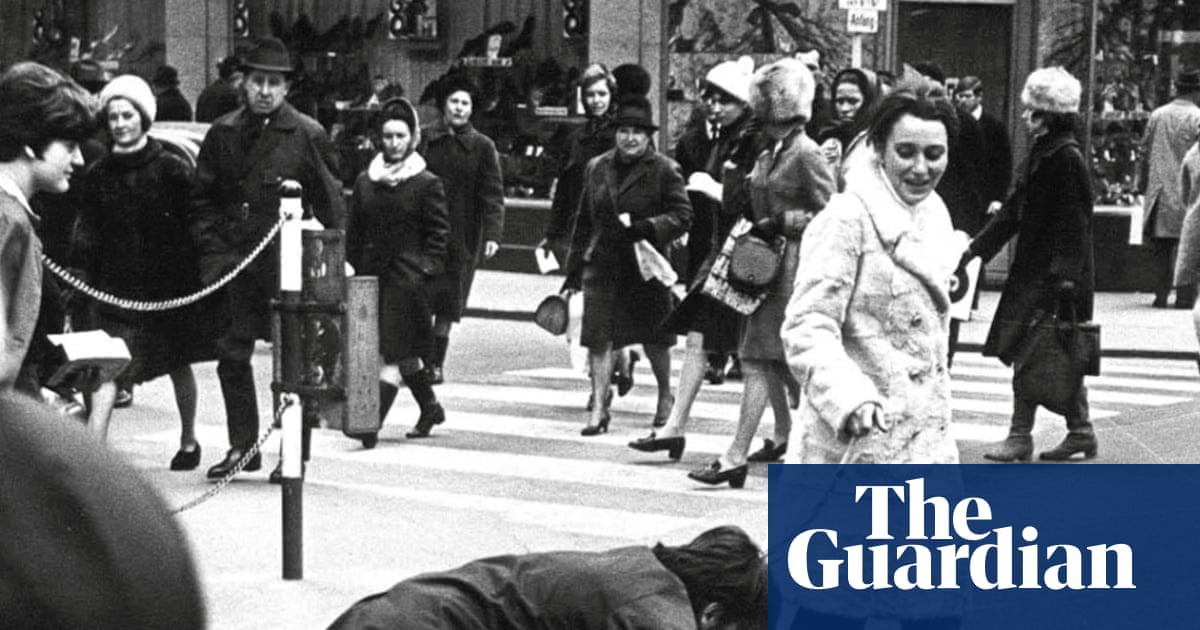
From men on dog leads to public breast-fondling, Valie Export’s art demanded a total feminist revolution | Art

From men on dog leads to public breast-fondling, Valie Export’s art demanded a total feminist revolution | Art

Punk, intellectual, feminist, theorist, brave as hell, vulnerable, funny, Valie Export was a hero to many women. Since the 1960s, she was driven by a fierce conviction that art and media would play an essential role in women’s liberation: that women must picture their own reality in the name of social progress. In Women’s Art: A Manifesto (1972), she wrote that women must “use art as a means of expression, so as to influence the consciousness of all of us”. What she demanded was revolution. I keep returning to her work. Can’t stay away. I have written about her in relation to violence in women’s art. Her work was heavy with explicit threat and pain, and she made evident the violence of forcing women’s bodies to inhabit structures that were not designed for them. For the 1973 performance Hyperbuliashe crept naked through a corridor of electrified wires, exposing herself voluntarily to shocks. She allowed me to use her 1976 photocollage The Birth Madonna for the cover of my book Acts of Creation. Showing a woman …

Carolyn Wood Sherif, pioneer of feminist psychology who foresaw the risks of scientific bias

Carolyn Wood Sherif, pioneer of feminist psychology who foresaw the risks of scientific bias

In the US state park of Robbers Cave, Oklahoma, Carolyn Wood Sherif is standing squinting up at the sun. The two wooden cabins before her rattle with shrieks and cries from excited 11-year-old boys. They have been split into two groups of 11 and encouraged to bond. Over three long, laborious weeks in the summer of 1954, Wood Sherif watches as these boys become enthusiastically dedicated to their allocated groups. When instructed to compete for resources, they grow hostile towards their opponents. The experiment descends into inter-group violence and aggression. This research was among the first naturalistic psychological studies to show how group formation can lead to prejudice and intense conflict. It is considered a classic study upon which the subdiscipline of social psychology – how mind and behaviour are influenced by the presence of other people – was born. Wood Sherif should have made her academic career from it. But in many ways, scientific research is a culture, a club. There are people with the power to warmly invite others to participate, and others …