All posts tagged: attitudes

NSS to host discussion on British attitudes to secularism

NSS to host discussion on British attitudes to secularism

The National Secular Society will present new research on attitudes in Britain to religion, society and politics at a free online event next month. NSS-funded research examined British attitudes on a wide range of issues relating to religion, including the established Church, faith schools, religious charities, free speech and extremism. The research was conducted by More In Common, a think tank which aims to build a more united, inclusive, and resilient society. Its mission is “to understand the forces driving us apart, to find common ground and help to bring people together to tackle our shared challenges”. At this online panel discussion on May 14th, NSS representatives will be joined by More In Common’s Andrew Fowler to walk through the findings and discuss what they reveal about the need to rethink the state’s approach to religion. NSS chief executive Stephen Evans, who will be on the panel, said: “At a time of rising extremism and concerns about community divisions, this research could not be more necessary. “Despite widespread unfamiliarity with the word ‘secularism’, the research …

A Compassionate History of American Attitudes Toward Animals

A Compassionate History of American Attitudes Toward Animals

I’ve long been interested in the many ways in which nonhuman animals (animals) have been viewed during different periods of history. A few years ago I published an post titled Henry Bergh and the Birth of the Animal Rights Movement—Bergh, the founder of the ASPCA, was called “a traitor to his species” because of his views on the moral status of animals—but other commitments sitting on my desk got in my way of doing more research. Because of my lingering interests in human-animal relationships and how these interactions have evolved over time, I was thrilled to learn of an outstanding book, Our Kindred Creatures: How Americans Came to Feel the Way They Do About Animals, by Bill Wasik, who was recently named the new Science editor of the New York Times, and veterinarian Monica Murphy. In their deeply researched and fascinating historical account of the moral transition of human attitudes toward animals, they cover the contributions of many people, including Bergh. Marc Bekoff: Why did you write Our Kindred Creatures? Bill Wasik and Monica Murphy: …

How empathy and race shape American attitudes toward refugees

How empathy and race shape American attitudes toward refugees

Global refugee crises often spark varying levels of public sympathy, with some displaced groups receiving warmer welcomes than others. A recent psychological study found that while a general sense of empathy strongly drives public support for all refugees, the race of the displaced individuals can sway the opinions of white Americans who otherwise exhibit low empathy. The research was published in The Journal of Race, Ethnicity, and Politics. People fleeing conflict or persecution rely on host countries to supply a safe harbor. Refugees differ from voluntary economic immigrants because they are forced to flee their homes to escape violence. Because their movement is humanitarian, host populations typically view them with less economic suspicion than undocumented immigrants. Still, public warmth toward displacement communities remains uneven. Political scientists Hannah L. Paul of the University of Missouri and Courtney J. Nava of Grinnell College wanted to understand the psychological roots of these disparities. They suspected that racial dynamics might condition the way Americans feel about incoming populations. Existing research shows that reading about the hardships of immigrants can …

‘Societal Time Bomb’ – Explosive German Police Study Finds Nearly Half All Muslims Under 40 Has ‘Islamist’ Attitudes

‘Societal Time Bomb’ – Explosive German Police Study Finds Nearly Half All Muslims Under 40 Has ‘Islamist’ Attitudes

Via Remix News, A newly released study by the German Federal Criminal Police Office (BKA), nearly 50 percent of Muslims under the age of 40 in Germany hold “Islamist” views, with these Muslims expressing an attraction to Islamism, a preference for Sharia law over the German Basic Law, and harboring anti-Semitic prejudices. The findings, described as “explosive in nature,” were featured in the latest edition of the “Motra Monitor.” The study reports that as of 2025, Muslims in Germany under the age of 40 (45.1 percent) hold “latent or manifestly Islamist attitudes.“ Some German politicians have already voiced their views on the study’s release. Wolfgang Kubicki, a prominent politician in the Free Democrats (FDP) and former MP, stated on X: “This study should set off all the alarm bells. It is a societal time bomb. We must not only talk about migration, but also about integration and religion. The policy of naively looking away has favored this development. The naivety must stop.” He further stated that “anyone who demands a caliphate is an enemy of …

Psychological network analysis reveals how inner self-compassion connects to outward social attitudes

Psychological network analysis reveals how inner self-compassion connects to outward social attitudes

A recent study published in the journal Mindfulness suggests that the way people treat themselves during difficult times is linked to their views on social equality. The research provides evidence that empathy serves as a bridge connecting self-compassion to a reduced preference for dominance over other social groups. These findings open up the possibility that fostering a kinder relationship with oneself might eventually promote broader social harmony. Self-compassion involves treating oneself with kindness and understanding rather than harsh judgment. While previous studies show that self-compassion benefits individual mental health, its impact on wider societal attitudes has remained somewhat of a mystery. Scientists wanted to explore how an individual’s internal relationship with themselves might extend outward to shape their feelings about different social groups. Specifically, the researchers examined a concept known as social dominance orientation. This psychological term refers to a person’s preference for inequality among social groups, where some demographics naturally dominate others. The scientists proposed that high self-compassion might relate to higher empathy, which in turn might connect to lower levels of this dominance …

Holding racist attitudes predicts increased psychological distress over time

Holding racist attitudes predicts increased psychological distress over time

New research published in the journal Comprehensive Psychiatry challenges the common belief that mental illness is a primary driver of racist attitudes. The findings suggest that the relationship actually works in the opposite direction, with prejudiced beliefs predicting an increase in psychological distress over time. The study also highlights social connectedness as a significant factor, indicating that a lack of social connection may fuel both prejudice and mental health struggles. Psychologists and social scientists have historically sought to understand the roots of extreme prejudice. A frequent explanation in both academic literature and media coverage is that racism is a symptom of poor mental health. This narrative often surfaces after events of mass violence, where the perpetrator’s actions are attributed to psychological instability rather than ideological conviction. For example, counterterrorism strategies frequently list mental health issues as a key risk factor for radicalization. Tegan Cruwys, a researcher at the School of Medicine and Psychology at The Australian National University, led a team to investigate the validity of this assumption. The researchers argued that attributing racism to …

Gen Z churchgoing is actually still declining, new British Social Attitudes Survey shows – Humanists UK

Gen Z churchgoing is actually still declining, new British Social Attitudes Survey shows – Humanists UK

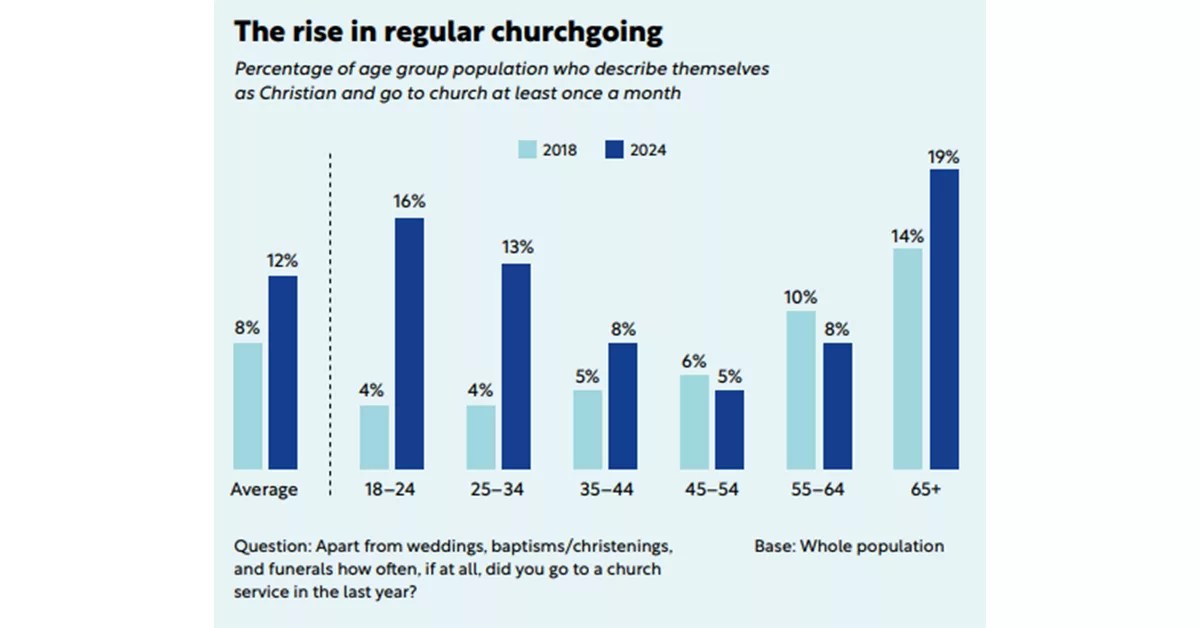
New analysis of recently published British Social Attitudes Survey data by Humanists UK has shown that churchgoing, including among Gen Z, has continued its long-term decline. The findings are consistent with the Church of England’s and Catholic Church’s own church attendance records. They undermine YouGov polling for the Bible Society which recently showed the opposite trend and triggered a spate of media coverage for what appeared to be a dramatic and sudden change. Last year the Bible Society reported on YouGov data comparing 2018 to 2024, apparently showing churchgoing was up among every age group, but particularly among the young: Source: the Bible Society’s Quiet Revival report. Data from the 2024 British Social Attitudes (BSA) Survey has now become available for this sort of detailed analysis. BSA is considered the gold standard of social research surveys in the UK because of its methodological rigour, including using probability-based random sampling, not online opt-in panels; online data collection with telephone as a backup option; and careful weighting and validation. It also publishes its datasets in full, which …

The psychological desire to be the “true” victim predicts anti-democratic attitudes

The psychological desire to be the “true” victim predicts anti-democratic attitudes

New research provides evidence that political partisans in the United States who perceive their group as a primary victim of injustice are more likely to support policies that undermine democratic norms. The study suggests that this phenomenon, known as competitive victimhood, fuels hostility by encouraging partisans to view their opponents as less than human. These findings were published in The Journal of Social Psychology. The events of January 6, 2020, highlighted a deep divide in the American political landscape. While many Democrats viewed the storming of the U.S. Capitol as an attack on democracy, many of the insurrectionists believed they were the victims of a stolen election. Chloe M. Nguyen and her colleagues sought to understand the psychological processes that turn these competing narratives of victimization into toxic polarization. The researchers, affiliated with the University of Pennsylvania, Duke University, University College Dublin, The University of Utah, and Tel Aviv University, aimed to determine if competing for victim status predicts support for anti-democratic actions. To investigate this, the research team conducted a large-scale survey involving 2,000 …

How ‘campus climate’ affects students’ attitudes to people of different religions

How ‘campus climate’ affects students’ attitudes to people of different religions

This year’s new university students are settling into life on campuses often notable for their diversity – and that includes in religion. Over 33,000 Buddhist students started university in the UK in 2023-24, for instance, alongside 769,220 Christian and 37,520 Sikh students. Universities have a role to play in helping their students relate to others of different religious backgrounds, especially at a time of concern over antisemitism and Islamophobia on campus. Our research has pinpointed some key things universities can do that make a positive difference. We can also highlight the things they shouldn’t do. We surveyed 1,000 students twice, one year apart. We wanted to investigate how the university environment, or campus climate, influences how students engage with other religions and worldviews. To assess this we asked students how far they agreed with statements such as “there are people of other faiths or beliefs whom I admire”, “I try to build relationships with people who hold religious or non-religious beliefs that I disagree with”, and “my faith or beliefs are strengthened by relationships with …