All posts tagged: limits

White nationalists march on DC, test free speech limits

White nationalists march on DC, test free speech limits

Members of the white nationalist group Patriot Front marched through Washington, D.C. over the July 4 holiday weekend, moving in formation through parts of the city and along transit routes as the capital hosted large-scale celebrations marking the 250th anniversary of American independence. Videos and photographs showed masked marchers wearing matching uniforms, carrying flags including variations of the U.S. flag and Confederate symbols and chanting slogans such as “Reclaim America” as they moved near Union Station, Metro stations and streets around the National Mall. Some commuters and bystanders documented encountering the group on public transit and in busy pedestrian areas, with social media posts describing confusion and unease during what was otherwise a heavily trafficked holiday weekend. The Metropolitan Police Department monitored the demonstration and reported no arrests, according to published reports, treating the march as a First Amendment-protected assembly so long as it remained peaceful and did not violate public safety laws. The Southern Poverty Law Center and the Anti-Defamation League have identified Patriot Front as a white nationalist organization that promotes extremist ideology …

Venezuela earthquakes highlight the limits of early warning systems

Venezuela earthquakes highlight the limits of early warning systems

Earthquakes still arrive without warning. That is the hard truth scientists have been forced to accept, despite a decade of advances in artificial intelligence, satellite monitoring and dense seismic networks. We are getting better at detecting earthquakes once they start. We are now better at estimating the damage they may cause. But we still can’t predict the exact time, place and size of a future earthquake. That may sound like failure. It is not. Over the past ten years, earthquake research has become more realistic. Instead of chasing precise prediction, scientists have focused on what can actually save lives: better risk forecasting, faster detection and earthquake early warning systems that can give people a few seconds to act before the strongest shaking arrives. A few seconds may not sound like much. In an earthquake, it can be the difference between standing under falling glass and getting under a sturdy table. What is an early warning system? Early warning systems work by detecting the first fast-moving seismic waves after a fault starts to rupture. These waves …

US Judges Block Trump’s Limits on Student Loan Forgiveness Program

US Judges Block Trump’s Limits on Student Loan Forgiveness Program

BOSTON, June 30 (Reuters) – Two federal judges on Tuesday blocked U.S. President Donald ⁠Trump’s ⁠administration from implementing a new rule stripping public service ⁠workers of eligibility for federal student loan forgiveness if it deems their employers to have a “substantial illegal purpose.” U.S. District ​Judge Myong Joun in Boston sided with Democratic-led states, cities and nonprofits that argued the Department of Education’s rule would allow it to target groups supporting immigration rights, transgender healthcare ‌and other causes the Trump administration disfavors by ‌disqualifying them from the Public Service Loan Forgiveness Program (PSLF). A short while later, a second judge in Washington, D.C., U.S. District Judge Amir Ali, likewise struck down the rule before ⁠it could take ⁠effect on Wednesday at the behest of four nonprofits involved in, among other things, immigrant rights advocacy. The ​program at issue allows borrowers to have their federal student loans forgiven after 10 years working for government or nonprofit employers. More than 1 million borrowers have received debt relief since Congress established it in 2007. Trump has argued the …

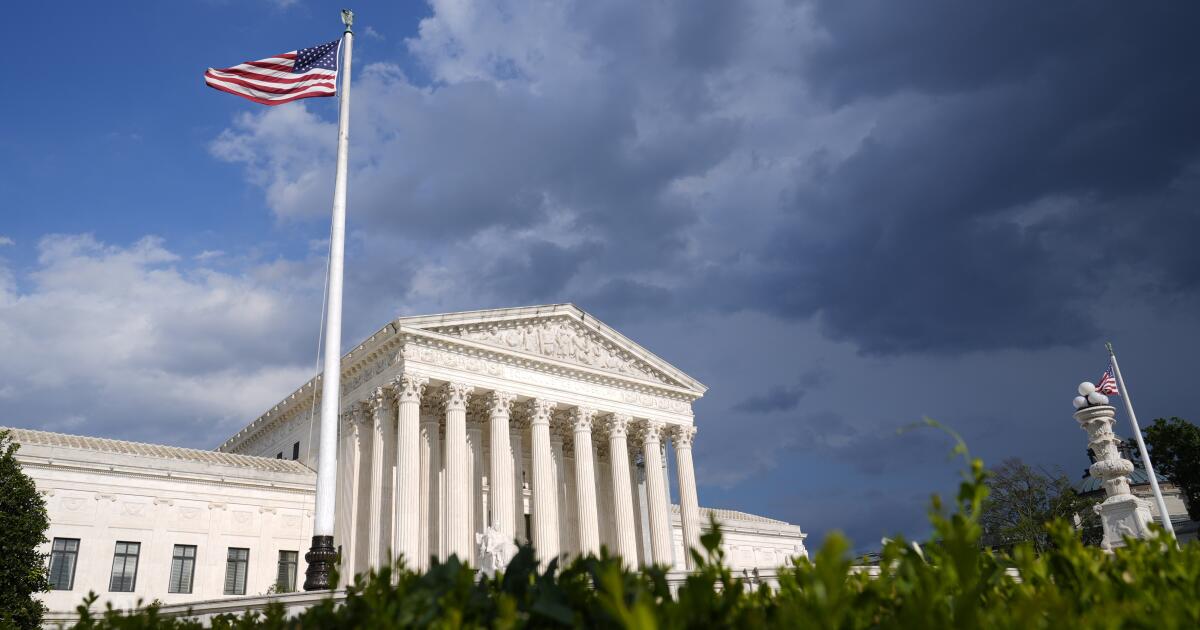
Supreme Court strikes down limits on political parties’ campaign spending, in win for GOP

Supreme Court strikes down limits on political parties’ campaign spending, in win for GOP

The Supreme Court on Tuesday struck down limits on the amount that political parties can spend in coordination with candidates for office, notching a win for Republicans who argued the restrictions violated the First Amendment. The 6-3 ruling, which was opposed by the court’s liberal justices, overturns coordinated-expenditure limits that had been in place for decades and withstood a previous legal challenge 25 years earlier. In doing so, it further expands the role that money will play in American politics —a role that had already been enlarged by rulings lifting limits on independent campaign spending by parties and corporations. Democratic Party organizations had opposed the challenge brought by the National Republican Senatorial Committee, arguing there was no Constitutional reason for the Supreme Court to convert parties’ “limited right into an unlimited one.” But the court’s majority concluded, “the political-party coordinated-expenditure limits at issue here are ‘disproportionate’ and are not ‘necessary’ and ‘narrowly tailored’” to satisfy the government’s interest in preventing the “circumvention of the base limits on contributions to candidates through earmarked contributions to parties.” …

Supreme Court strikes down limits on political party spending : NPR

Supreme Court strikes down limits on political party spending : NPR

The U.S. Supreme Court Chip Somodevilla/Getty Images hide caption toggle caption Chip Somodevilla/Getty Images The Supreme Court yet again loosened campaign finance restrictions on Tuesday by striking down limits on how much political parties may spend on candidates. By a 6-to-3 vote along ideological lines, the court ruled the law, which had been enacted in 1974, violates political parties’ First Amendment rights. Justice Brett Kavanaugh wrote the majority opinion. “Whether the Democratic Party, the Republican Party or other parties, all political parties and candidates going forward can compete equally under the same rules regarding coordinated expenditures and can structure their fund-raising, spending and political speech on a level playing field as they see fit within the law,” he wrote. At issue in the case was a post-Watergate law that Congress passed to limit the amount of money individuals can give to political parties. The law, the Federal Election Campaign Act, also limited how much money political parties can spend on their candidates. Other types of organizations, like political action committees and Super PACs, have no …

Supreme Court limits police use of cellphone data to find crime suspects

Supreme Court limits police use of cellphone data to find crime suspects

WASHINGTON  — The Supreme Court cast doubt Monday on whether police may obtain cellphone data to find crime suspects. In a 6-3 decision, the justices said this location information showing where a cellphone user has traveled is personal and private and subject to the protection of the 4th Amendment’s ban on unreasonable searches. Justice Elena Kagan said these “records serve as a personal journal of a user’s movements.” She said the information “resembles other private materials — think of emails, documents, photographs, or calendars—that even if stored on Google’s servers, a user reasonably views as his own…and reasonably expects to be shielded from the inquisitive eyes of the government.” Because an “individual has a legitimate expectation of privacy in his cellphone location data,” she said police investigators need a valid search warrant from a magistrate. The court stopped short of deciding the proper basis for a search warrant in such cases. Instead, the justices sent the case back to judges in Virginia. But the outcome casts doubt on “geofence warrants.” In recent years, police have gone …

Will new graduate student loan limits drive down tuition? : NPR

Will new graduate student loan limits drive down tuition? : NPR

Students toss their mortarboards in the air at a 2018 commencement ceremony at Wesleyan University in Middletown, Conn. Eduardo Munoz Alvarez/Getty Images hide caption toggle caption Eduardo Munoz Alvarez/Getty Images For the past two decades, graduate students have been able to take out an unlimited amount of federal student loans to cover the full cost of their education. If they needed $60,000 a year, they could borrow $60,000 a year, year after year. The Trump administration has a plan to change that by capping graduate school loans for many students at $20,500 a year, and $100,000 overall — effective July 1. (A federal court temporarily blocked a small piece of that plan, but the U.S. Education Department confirmed to NPR that loan limits will indeed begin July 1.) In a year packed with changes to higher education policy, this new loan limit is one of the biggest, and one of the most controversial. U.S. Secretary of Education Linda McMahon says the endgame is to force colleges to slash their tuition prices. “College costs are just …

Google limits Meta’s use of its Gemini AI models, FT reports

Google limits Meta’s use of its Gemini AI models, FT reports

June 28 : Google has put limits on Meta’s use of its Gemini AI models after the social media company sought more computing capacity than the rival tech group could provide, the Financial Times reported on Sunday.  Google, owned by Alphabet, told Meta around March it could not meet the full Gemini capacity the company had sought to purchase, the newspaper said, adding that the shortfall disrupted and delayed some of Meta’s internal AI projects. Several other Google clients have also been affected, though to a lesser extent, according to the report. Meta has been particularly impacted due to its exceptionally high demand for Google’s models, the FT said. Reuters could not immediately verify the report, which cited people familiar with the matter. Google and Meta did not immediately respond to requests for comment outside business hours.  Due to the restrictions, Meta has encouraged staff to be more efficient with AI tokens, the units that measure AI usage, the FT report said.  Even as companies continue to spend billions on chips and data centres, they …

The Strengths and Limits of IKEA Smart Home Devices in 2026

The Strengths and Limits of IKEA Smart Home Devices in 2026

IKEA’s smart home ecosystem in 2026 continues to prioritize simplicity and affordability, making it a practical choice for users seeking accessible automation solutions. As highlighted by Smart Life, IKEA’s devices shine in foundational areas like motion-activated lighting and energy-saving routines, thanks to their Matter compatibility and ease of integration with platforms such as Home Assistant and Apple Home. However, their functionality remains limited to basic automations, lacking the advanced features needed for dynamic, context-aware systems. For example, while IKEA’s smart bulbs and motion sensors are reliable for straightforward tasks, they fall short in supporting advanced security or climate control setups. Explore how IKEA’s smart devices can fit into your home by understanding their strengths and limitations. You’ll gain insight into practical applications like automating lighting schedules or enhancing home security with motion-triggered alerts. Additionally, discover how combining IKEA products with other Matter-compatible systems can bridge gaps in functionality, allowing more complex automations. Whether you’re starting small or expanding an existing setup, this guide offers a clear look at how IKEA contributes to a balanced smart …

OpenAI limits GPT-5.6 rollout after government request, says restrictions shouldn’t be the norm

OpenAI limits GPT-5.6 rollout after government request, says restrictions shouldn’t be the norm

OpenAI is limiting the release of its newest AI models to a “small group of trusted partners” at the behest of the U.S. government, the company said Friday. The next generation GPT-5.6 lineup includes Sol, its flagship model; Terra, a more balanced model for everyday use; and Luna, a faster, lower-cost option. Although Sol is the company’s most powerful model, the Trump administration has restricted the release of all three. OpenAI said the preview is limited to partners “whose participation has been shared with the government.” The administration’s request comes as the U.S. government puts new pressure on AI companies to restrict their most advanced systems. After Anthropic released its most powerful public model Fable 5, the administration ordered the company to remove access for any foreign national, prompting Anthropic to take the model down entirely.  The incident has brought up questions of how much power the government should have over AI model releases. Dean Ball, a former White House AI adviser and soon-to-be OpenAI employee, says President Trump’s recent executive order — which asks …