


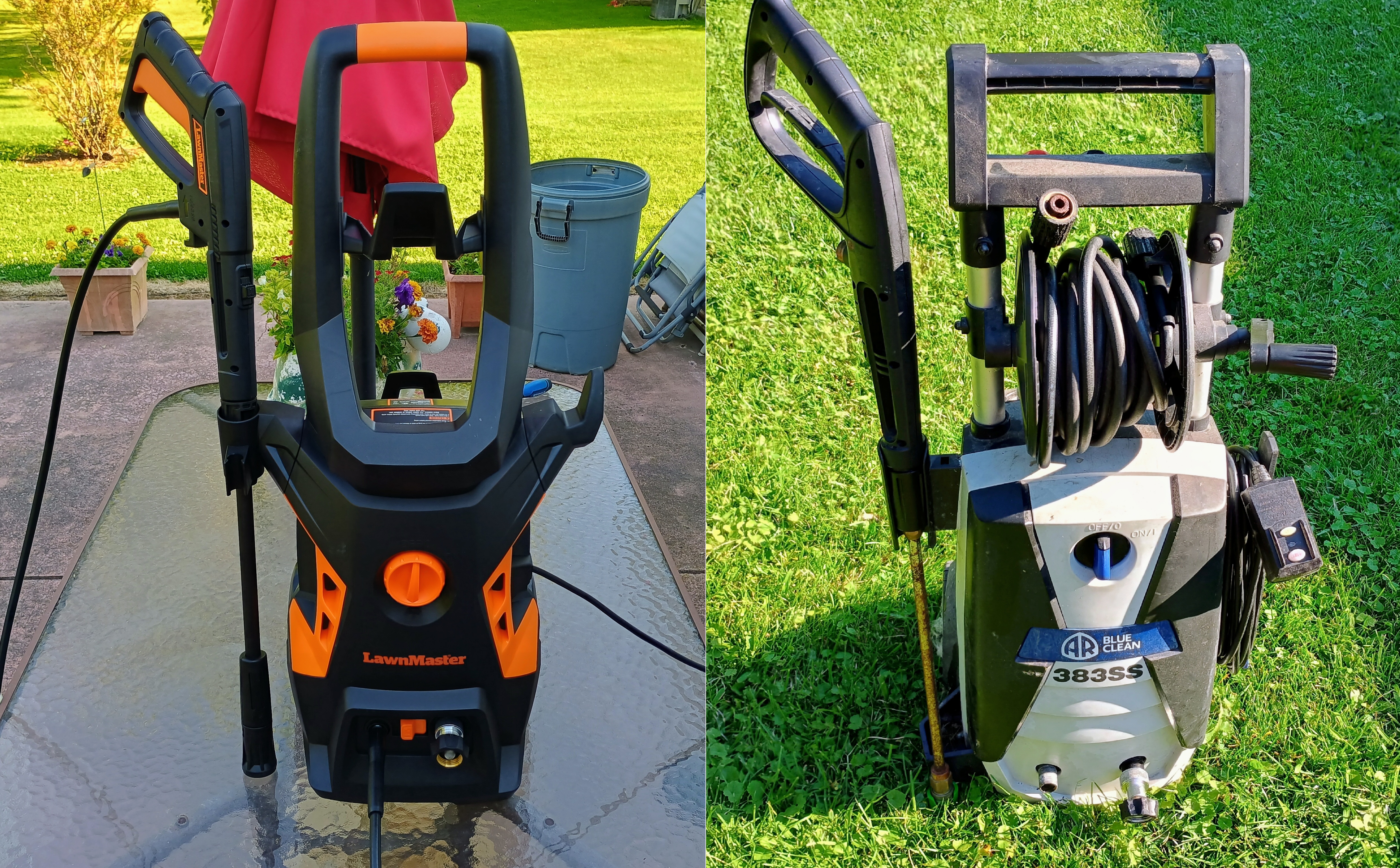
Electric pressure washers promise a way to clean patios, driveways, cars and siding without the noise, fuel or maintenance associated with gas-powered machines. Because of their convenience, it’s no surprise that these battery and corded electric models dominate our testing. But with prices ranging from entry-level to premium, it’s fair to ask how much performance you get for your money, especially at the higher end of that spectrum.
To find out, I compared the LawnMaster LT506-2000A pressure washer, which retails for $100 to $120 depending on PSI, with my AR Blue Clean 383SS. This specific 383SS model doesn’t appear to be available for sale anymore. I bought it for about $250 a few years ago, and while the specific 383SS model doesn’t appear to be available, similar models go for $300 to $400.
The LawnMaster is positioned as a budget-friendly machine, while the AR Blue Clean has a longer track record and a more established feature set. I tested both washers on the same surfaces, using the same water source and comparable spray settings.
The LawnMaster performed extremely well, even when considering the AR washer’s age, and especially given the price difference. For a budget model, the LawnMaster is an impressive machine and will more than suffice for most homeowners.
How does the hardware compare?
The LawnMaster LT506-2000A is rated for up to 2,300 pounds per square inch and 1.4 gallons per minute. Its owner’s manual lists a rated pressure of 1,650 PSI and a 13-amp, 120-volt motor. The machine weighs approximately 22.6 pounds.
The AR Blue Clean 383SS produces up to 1,900 PSI and 1.3 GPM and also uses a 13-amp motor. It weighs approximately 32 pounds and includes a 30-foot high-pressure hose, a 35-foot power cord, a hose reel and an integrated 28-ounce detergent tank.
Those numbers give the LawnMaster an advantage in maximum pressure, although maximum PSI is only one element of a pressure washer’s performance. Nozzle design, pump consistency, water flow and how easily the machine can be positioned all affect how well it removes dirt.
Both models are intended for cold-water use and suit typical household cleaning tasks rather than heavy-duty commercial work. Neither should be treated like a professional gas-powered pressure washer, particularly for removing deeply embedded grime across large areas. While gas-powered pressure washers could be expected to handle power-intensive tasks like stripping paint, or could supply pressure across a wide enough zone to clean large driveways or even small parking lots, smaller models like the ones I tested here are more suitable to household tasks like washing cars, patio furniture, grills and small decks.
Design, assembly and accessories
The LawnMaster arrives with an adjustable spray gun, high-pressure hose, turbo lance, foam bottle, cleaning brush and wheel-hub brush. Its 20-foot hose and 35-foot power cord provide reasonable reach for cleaning a vehicle or small patio, although the hose is shorter than the one supplied with the AR Blue Clean.
The included brushes could make the LawnMaster especially appealing to people who plan to clean cars, wheels and garden equipment. They also reduce the need to buy extra accessories right away. The foam bottle is useful for applying detergent, though you shouldn’t expect the same thick foam produced by a dedicated foam cannon.
The AR Blue Clean takes a more conventional approach. It includes a pro-style spray gun, quick-connect nozzle tips, a rotary or turbo nozzle, a detergent tank and onboard storage. Its hose reel makes setup and storage less awkward and is one of its most useful design features. The trade-off is weight: At roughly 32 pounds, the 383SS is noticeably heavier than the LawnMaster at just over 22 pounds.
In practice, the LawnMaster is easier to lift and carry, while the AR Blue Clean feels more substantial when being pulled across a driveway. Both models include a Total Stop-style system that shuts off the motor when you release the trigger, reducing unnecessary pump operation.
In terms of assembly, it’s been a while, but I remember the Blue Clean being fairly fiddly, and every time I reconnect the hoses and nozzle, I inevitably spend more time than I’d like tightening and troubleshooting leaks (though, again, this is a pressure washer that’s a little over 3 years old).
The LawnMaster, on the other hand, was a breeze to assemble. Aside from a handful of screws, most components snap together easily, and the instructions were simple and clear. I had the unit unboxed, assembled and connected in less than 15 minutes.

Three washing tests
For all the tests I conducted, I used the default 25-degree nozzle tip on the AR Blue Clean. The LawnMaster comes with an adjustable nozzle, so you can easily change the spray width (and pressure) on the fly.
I measured the Blue Clean’s width by spraying a section of dirty pavement, then adjusted the LawnMaster nozzle to match it at the same distance, mimicking a 25-degree nozzle. I did single passes at medium speed with both to give a fair impression; naturally, a secondary pass or a longer, lingering sweep would yield better results from both models.
Test 1: Vehicle cleaning
For the first test, I used both machines to wash the side of my black 2017 Chevy Bolt. I first applied a mud slurry to the side panels and wheels, then cleaned the front panel and wheel with the AR Blue Clean and the rear with the LawnMaster.

AR Blue Clean result: The AR did a decent job on an initial pass, but left significant dirt and streaking in its wake. Dirt was still visible on the sidewalls of the tires and on several areas of the door panel.

LawnMaster result: The LawnMaster yielded better results, particularly on the rear tire, though it did also leave a fair amount of smudging and streaking after a single pass.

The main difference was that the LawnMaster didn’t leave full patches of dirt in its wake, while the AR did. The LawnMaster appeared more comprehensive and provided slightly better control and coverage.
Test 2: Concrete patio
Next, I tested both machines on a similarly dirty section of my back patio, which is finished, sealed concrete. This surface was heavily stained and had large patches of algae. I first sketched out two rectangles on the surface, then used the AR Blue Clean on the left and the LawnMaster on the right.

AR Blue Clean result: The AR did a decent job cleaning up the general patina and staining, but it did little to remove the stubborn algae, much of which remained after a single pass.

LawnMaster result: The LawnMaster did a much better job, removing not only the staining and patina but also blasting away the vast majority of visible algae in one pass.

This test clearly showed how the LawnMaster’s higher maximum pressure translated into faster cleaning. It did a much better job cleaning the concrete in a single pass; while I removed most of the remaining algae with the AR Blue Clean in subsequent passes, the LawnMaster handled it in one quick run.

Test 3: House siding
Finally, I sloshed more of the mud slurry onto the gray siding of my house and, following the pattern from the first two tests, ran the AR Blue Clean on the left and the LawnMaster on the right.

LawnMaster result: The LawnMaster easily blasted away the mud from both the siding and the concrete pad beneath it, leaving them cleaner than the surrounding surfaces.

AR Blue Clean result: The Blue Clean also did an excellent job on the siding, easily and fully cleaning both the siding and the concrete below it in one pass.

This is the test where the two were closest in performance, likely because the slurry was more diluted or didn’t cling to the side of the house as much. For an application like this, the AR Blue Clean was perfectly suitable, though the LawnMaster looks significantly more impressive given their relative prices.
Which one should you buy?
The LawnMaster LT506-2000A is an attractive combination of low weight, high pressure and varied accessories. Given the LawnMaster’s portability and maximum cleaning power, and the fact that it comes in at $150 less than I paid for the AR Blue Clean, it’s easily the better value.
One consideration for any piece of equipment from an upstart budget brand is longevity, which is more difficult to test. For $100, though, it might be worth the risk, especially if you plan to use it only sparingly.
Based solely on my testing, the LawnMaster matched or significantly exceeded the AR Blue Clean in overall cleaning performance. Given its price and the excellent job it did in all three tests, it not only easily surpassed my (admittedly aging) Blue Clean, but it’s an easy recommendation overall for a value-priced, electric pressure washer.

See full bio