


In 1675, Newton famously wrote , “If I have seen further it is by standing on the shoulders of Giants.”
Behind the dome of a series of European Southern Observatory telescopes, the Milky Way towers in the southern skies, flanked by the Large and Small Magellanic Clouds, at right. Although there are several thousand stars and the plane of the Milky Way all visible to human eyes, there are only four galaxies beyond our own that the typical unaided human eye can detect. We did not know they were located outside of the Milky Way until the 1920s: after Einstein’s general relativity had already superseded Newtonian gravity, demonstrating how significantly we stand on the shoulders of the giants that have come before us.
Credit: ESO/Z. Bardon (www.bardon.cz)/ProjectSoft (www.projectsoft.cz)
But in the Universe, cutting-edge telescopes and instruments reveal the greatest cosmic depths.

Spirals, initially recorded as faint, fuzzy objects with no discernible structure through more primitive telescopes, were clearly observed since the mid-1800s to be prevalent in the night sky. But their nature was a mystery, and a democratic attempt to settle the issue in 1920 only raised more unanswered questions. It wasn’t until 1923, and the identification of individual stars within one of them (Andromeda), that their extragalactic nature began to be understood.
From Earth, the Triangulum galaxy (recorded 1654) is the farthest naked-eye object typically visible.

The spiral galaxy Messier 33, shown as imaged by an amateur astronomer with X-ray data from NASA’s Chandra overlaid in pink, is also known as the Triangulum galaxy: a faint galaxy visible in the southern skies. First recorded in 1654, it is the faintest object visible by typical, unaided human eyes at a distance of 2.878 million light-years: several hundred million light-years more distant than Andromeda.
Some exceptional observers claim to see Messier 81: 12 million light-years away.
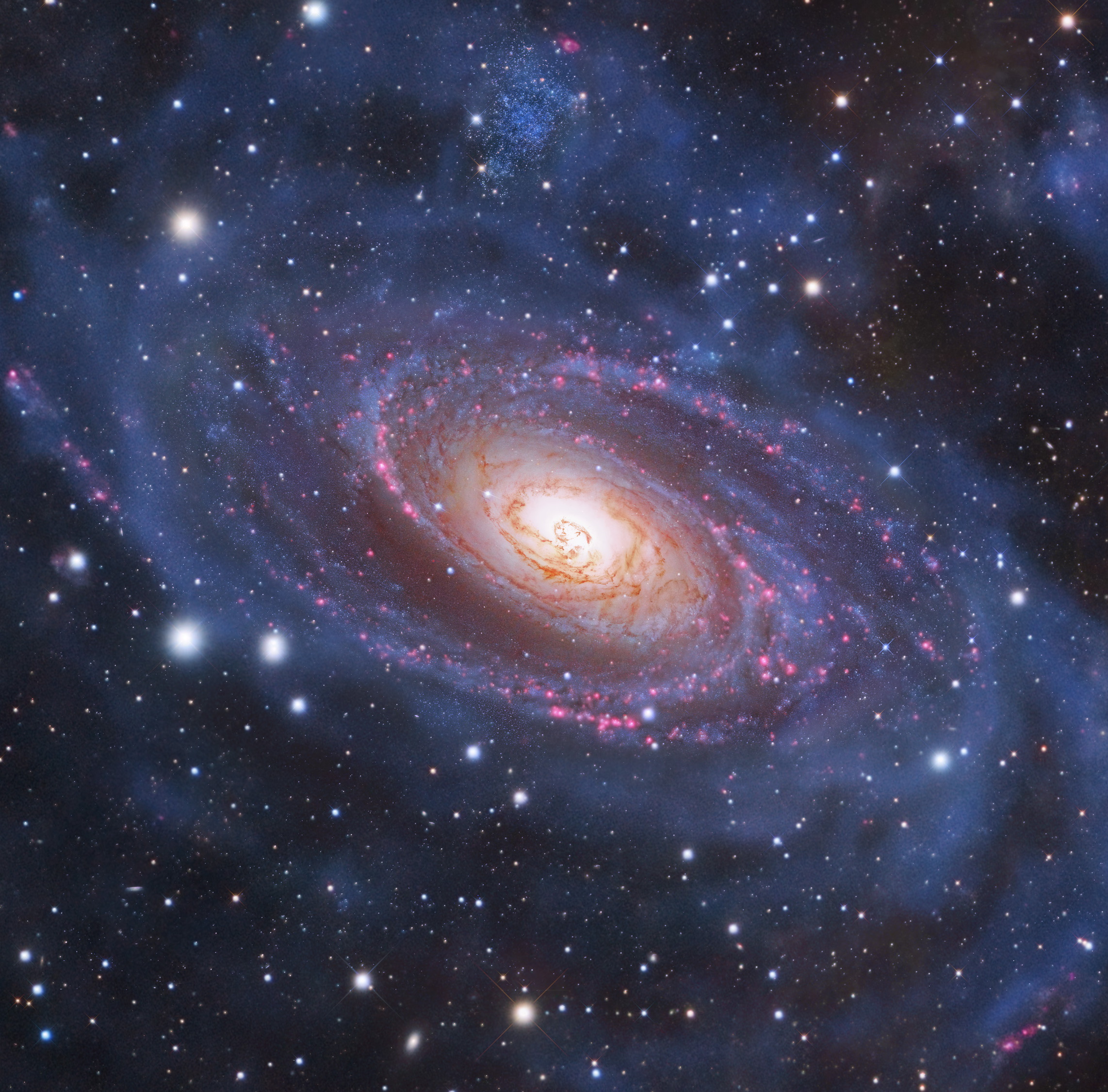
This zoomed-in view of the stars, gas, dust, and hydrogen surrounding Messier 81 showcases a tremendous population of young, newly formed stars, but represents only a fraction of the M81 Group’s mass. Although this galaxy is only about 70% the diameter of the Milky Way, the mass of the group adds up to over ~1 trillion solar masses. At 12 million light-years distant and its current brightness, a few human observers, under ideal conditions, claim to be able to see this object with their naked eye: the most distant known object for which this is possible.
In 1779, Charles Messier recorded Messier 58: 68 million light-years distant.

Galaxy Messier 58, recorded in 1779 by Charles Messier, is the most distant galaxy in the Messier catalog at 62 million light-years distant. Although its distance and nature were unknown to Messier (and to others for over 100 years after its discovery), it was, for a time, the most distant object discovered and viewed by humanity.
William Herschel surpassed that in 1786, revealing NGC 1 at 185 million light-years.
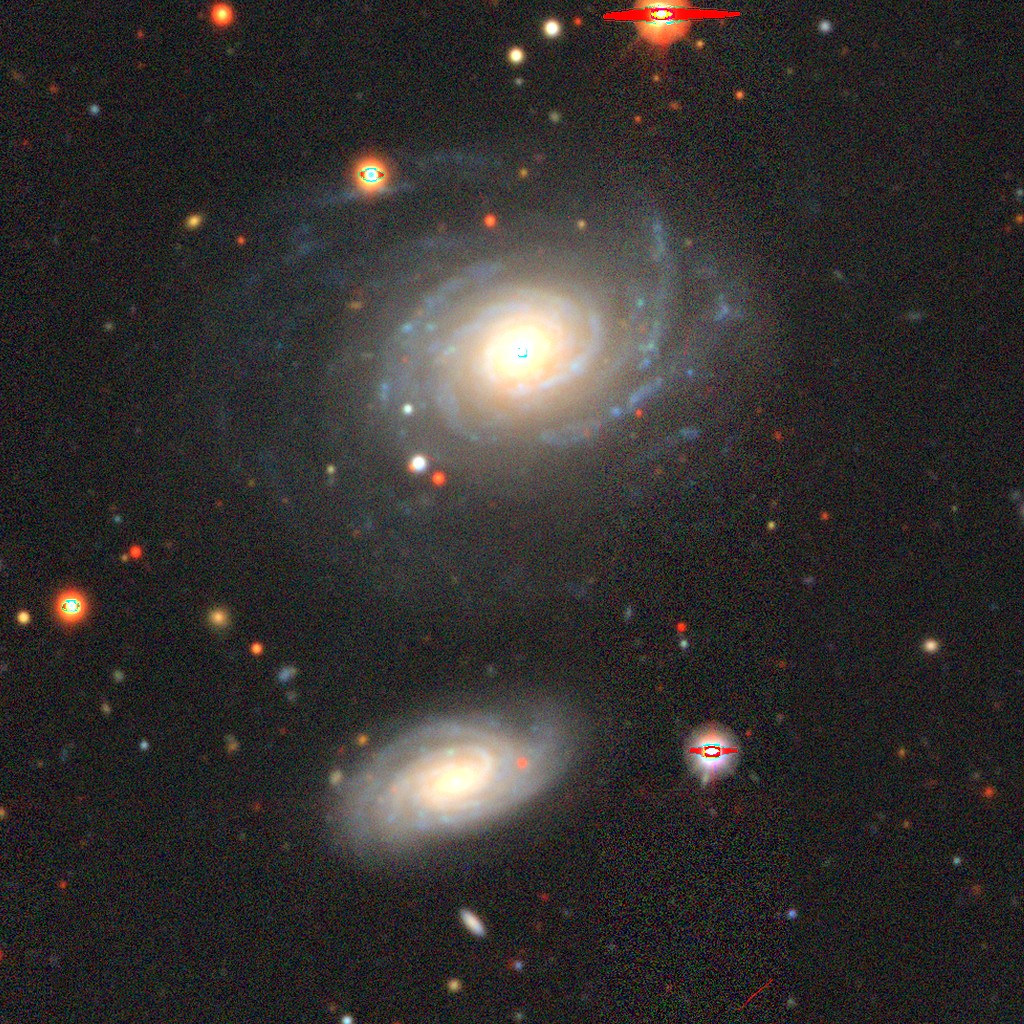
Galaxy NGC 1, at top, was the first object recorded in William Herschel’s general catalog from 1786, but was not re-recorded until the 1860s. Its distance of 211 million light-years made it the most distant object known and recorded for around a century, although its distance was not known until the 20th century. Below it, the much fainter NGC 2 is nearly twice as distant. Galaxies such as this, despite being hundreds of millions of light-years away, have not appreciably evolved in mass, size, or stellar age from the nearest galaxies to us; one must look much farther away to see such effects.
In 1887, OJ 287 was photographed; its measured distance is 3.5 billion light-years.
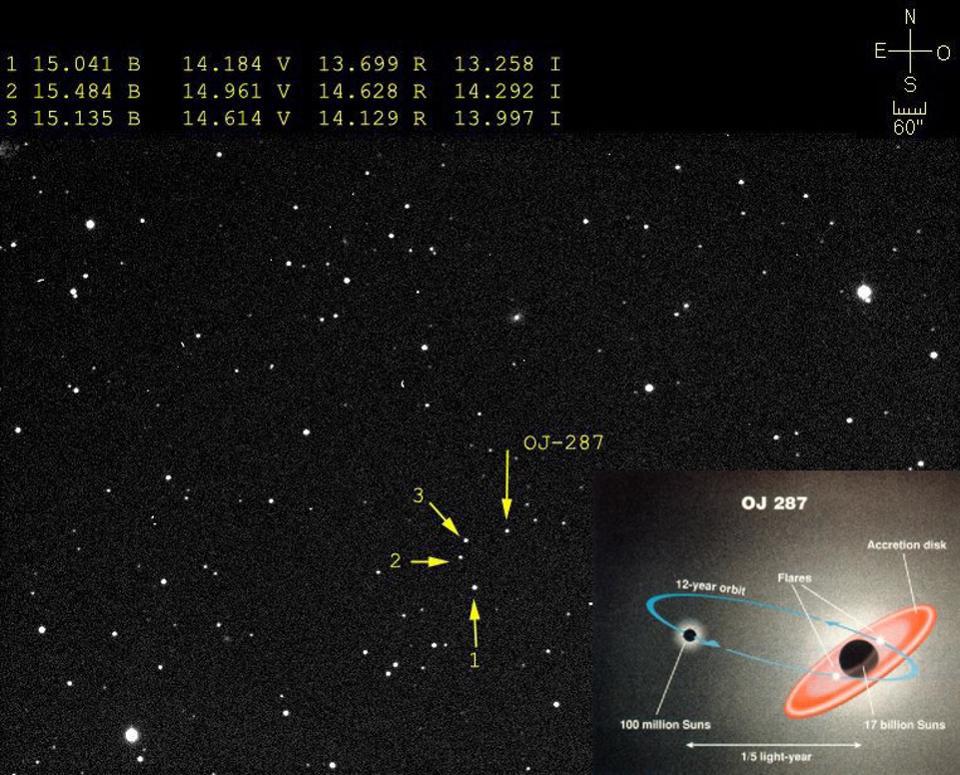
The most massive pair of black holes in the known Universe is OJ 287, whose gravitational waves will be so long in wavelength that they’ll even be out of reach of LISA. A longer-baseline gravitational wave observatory could see it, as could, potentially, a sufficiently precise pulsar timing array. Although OJ 287 was first imaged in 1887, its nature and distance were not determined until the 1960s.
However, bright galaxies in clusters — e.g., Coma, Boötes, and Hydra — were historically recorded as more distant.
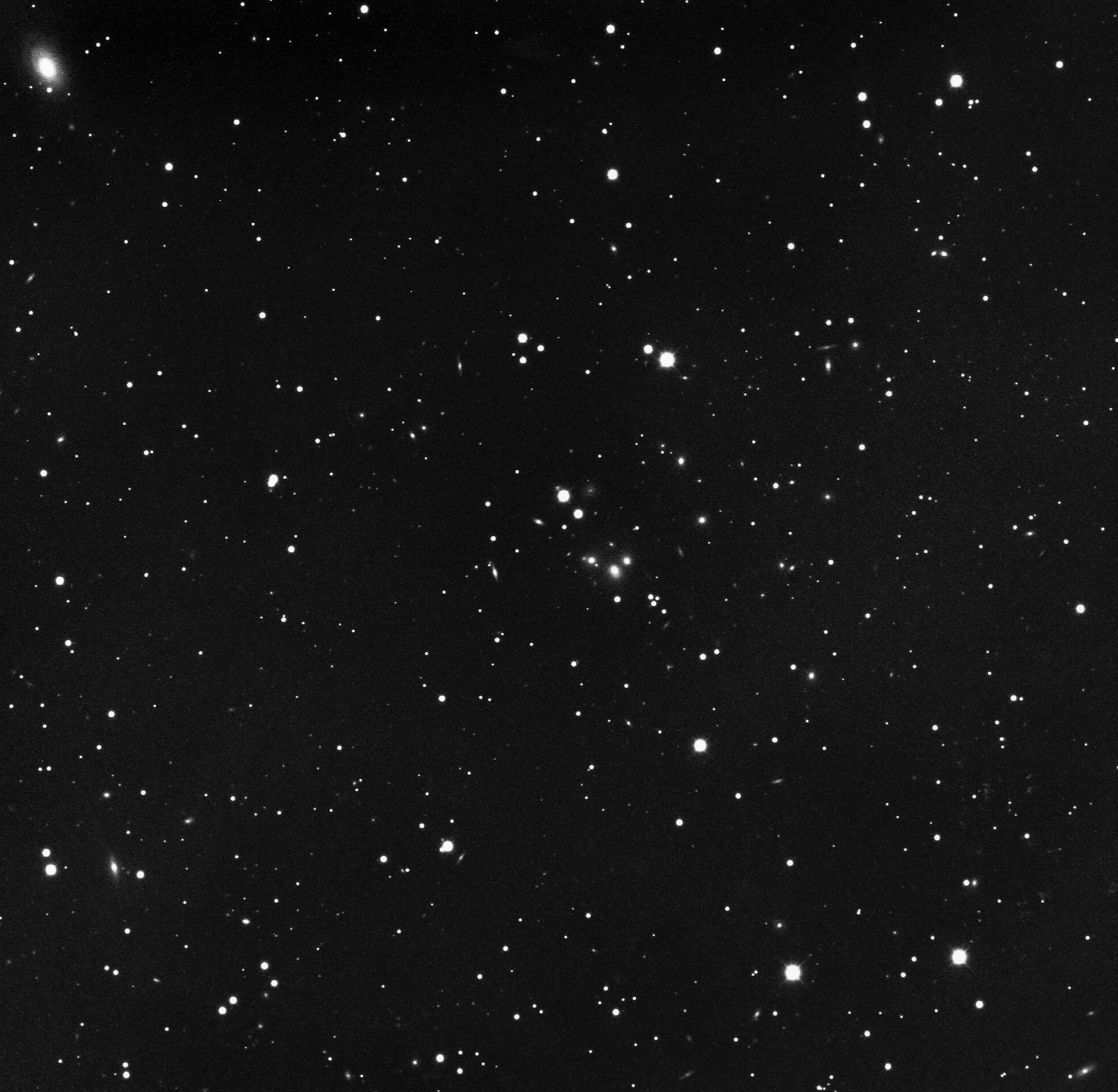
This view of the Gemini Cluster of galaxies, taken in 1975, contains the galaxy known as LEDA 20221 (MCG+06-16-021), which is the brightest galaxy within that cluster. The brightest galaxy within that cluster was discovered in 1932, and with a distance in excess of 1 billion light-years from us, was the first object discovered to cross that vaunted threshold. Although OJ 287 is 3.5 billion light-years away and was discovered much earlier, its distance was not measured until many decades later.
Radio galaxies and quasars smashed those records beginning in the 1960s.
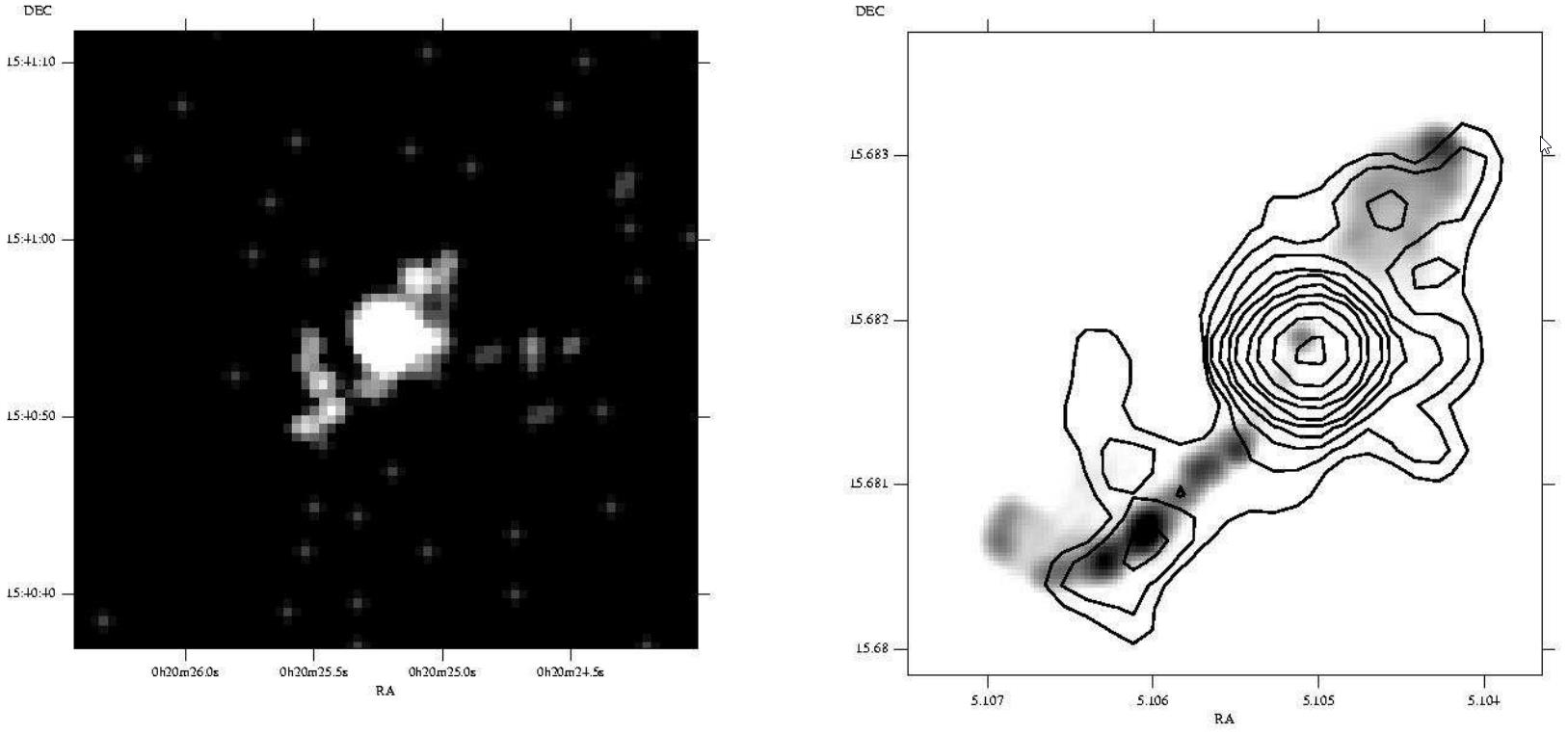
As shown with Chandra X-ray data (left) and with contours of radio data from the Very Large Array (right), quasar 3C 9 broke the cosmic distance record in 1965 and became the first object with a redshift of 2 or greater and is located at a distance of 16 billion light-years. Although many more quasars would extend that record, it wouldn’t be until 1997 that galaxies re-took the record from quasars.
Quasars held the record until 1997, when galaxies CL 1358+62 G1 & G2 took it back.
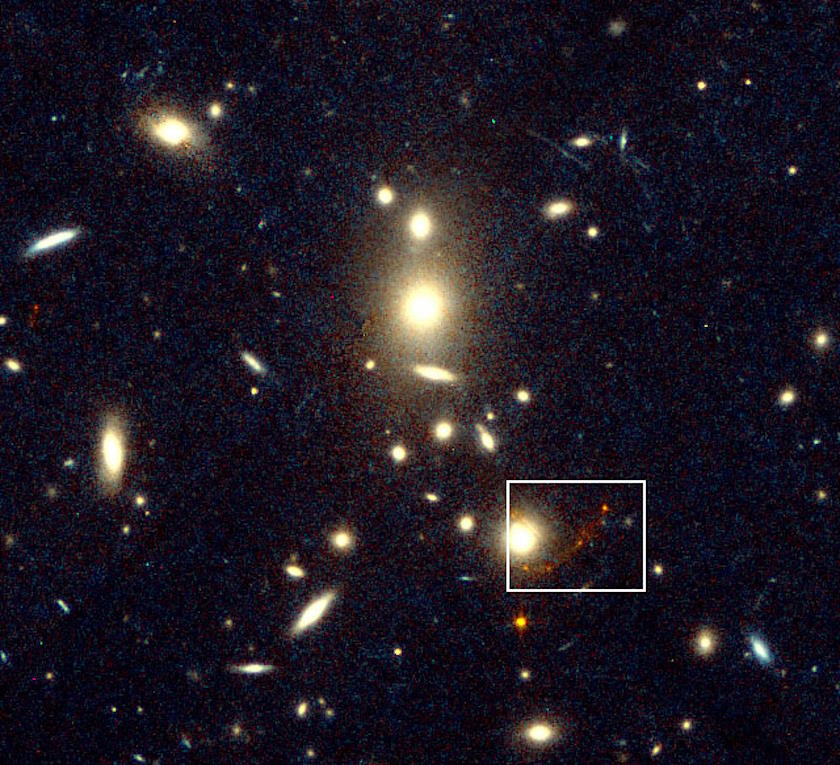
The galaxy cluster shown here, CL 1358+62, is presently lensing two much more distant background galaxies, as shown in the white box by their red arcs. Those two objects, discovered on July 31, 1997 by Marijn Franx and Garth Illingsworth, broke the cosmic distance record at the time and became the first galaxies to be the cosmic record-holder for distance since 1960, when quasars first usurped them.
The last record-holding quasar was SDSS J1030+0524, surpassed by galaxy HCM-6A in 2002.
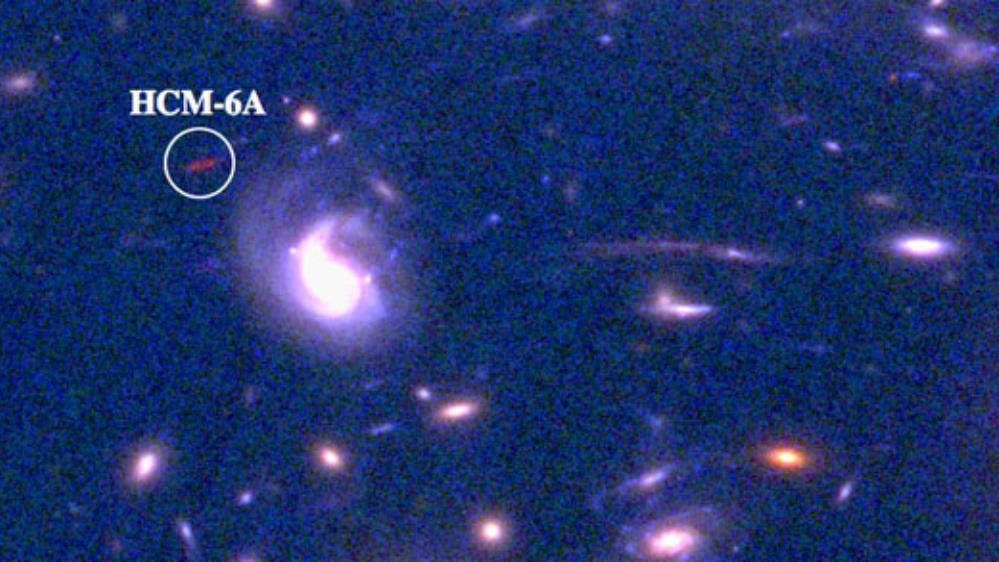
The galaxy HCM-6A, shown here, is stretched and magnified by the effect of gravitational lensing by the foreground cluster of galaxies in front of it: cluster Abell 370. In 2002, the discovery of this galaxy, at a redshift of z=6.56 and a distance of ~28 billion light-years, took the record back for galaxies from quasars, and while a gamma-ray burst held the record for 6 years subsequently, quasars have never held the record since.
Gamma-ray burst GRB 090423, in 2009, broke IOK-1‘s prior galactic distance record, reaching 30 billion light-years.
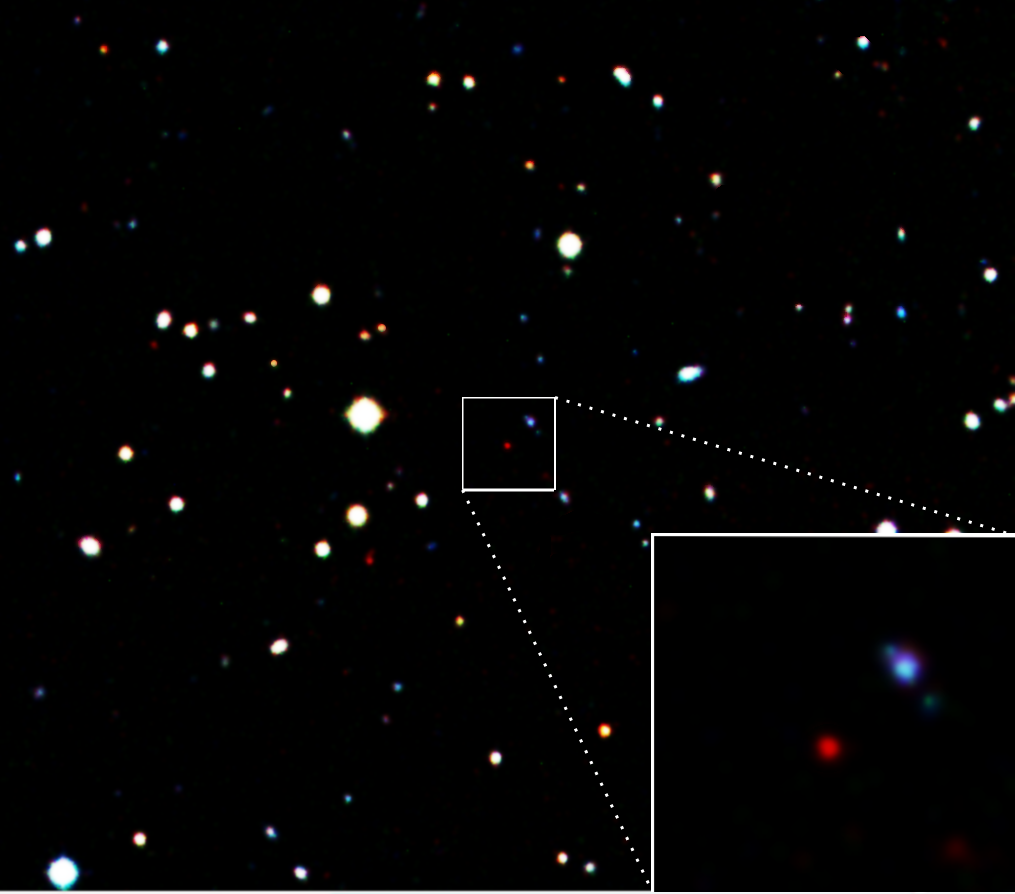
This false-color image, taken in the infrared with the GROND instrument at the MPI/ESO 2.2m telescope on La Silla in Chile, reveals the afterglow and redshift/distance of the spectacular April 23, 2009 gamma-ray burst GRB 090423. From 2009-2015, it was the most distant object ever discovered, until Hubble gave the record back to galaxies.
Hubble galaxies EGSY8p7 and GN-z11 retook the record, which galaxies still hold.
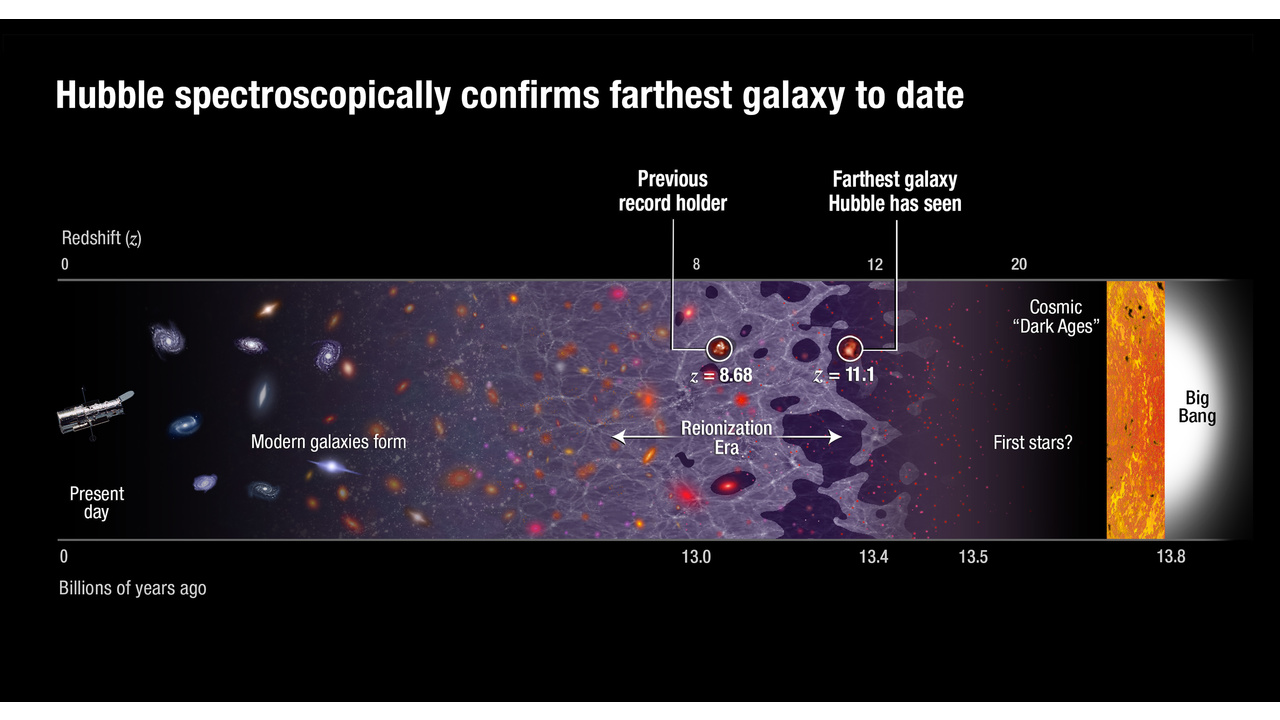
Only because the most distant galaxy spotted by Hubble, GN-z11, is located in a region where the intergalactic medium is mostly reionized, was Hubble able to reveal it to us at the present time, breaking the prior record held by EGSY8p7. Other galaxies that are at this same distance but aren’t along a serendipitously greater-than-average line of sight as far as reionization goes can only be revealed at longer wavelengths, and by observatories such as JWST. At present, GN-z11 has been relegated to the 14th most distant galaxy known.
More recently, JWST galaxies:
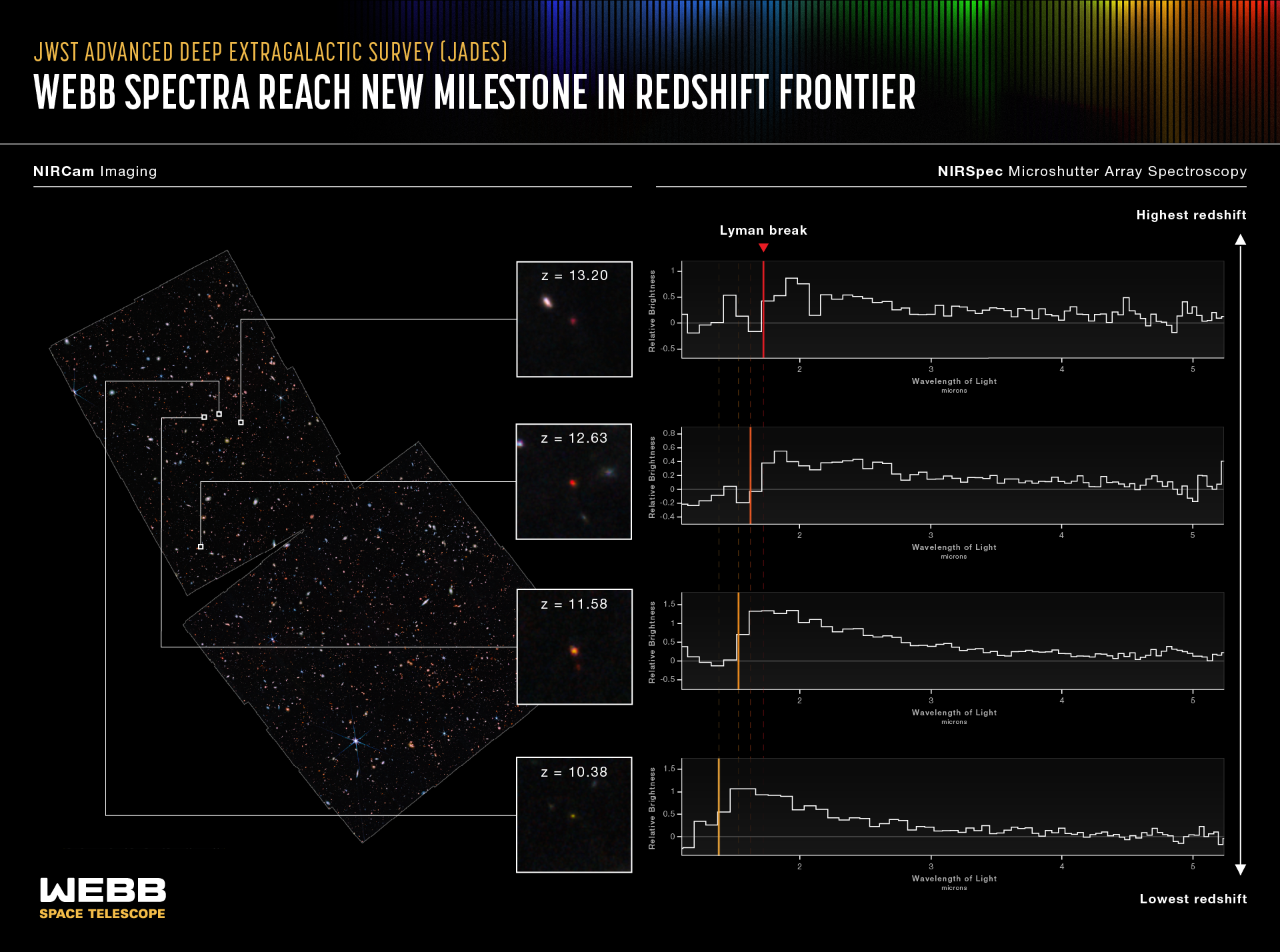
In 2022, the four most distant galaxies that were identified as part of JADES included three that surpassed GN-z11’s threshold for “most distant galaxy” previously set by Hubble. JADES-GS-z13-0 held the cosmic distance record for two years, until it was surpassed in the same field-of-view by JADES-GS-z14-0, and as of 2026, sits at #5 on the all-time list, behind four other galaxies also discovered by JWST.
Credit: NASA, ESA, CSA, M. Zamani (ESA/Webb), Leah Hustak (STScI); Science credit: Brant Robertson (UC Santa Cruz), S. Tacchella (Cambridge), E. Curtis-Lake (UOH), S. Carniani (Scuola Normale Superiore), JADES Collaboration
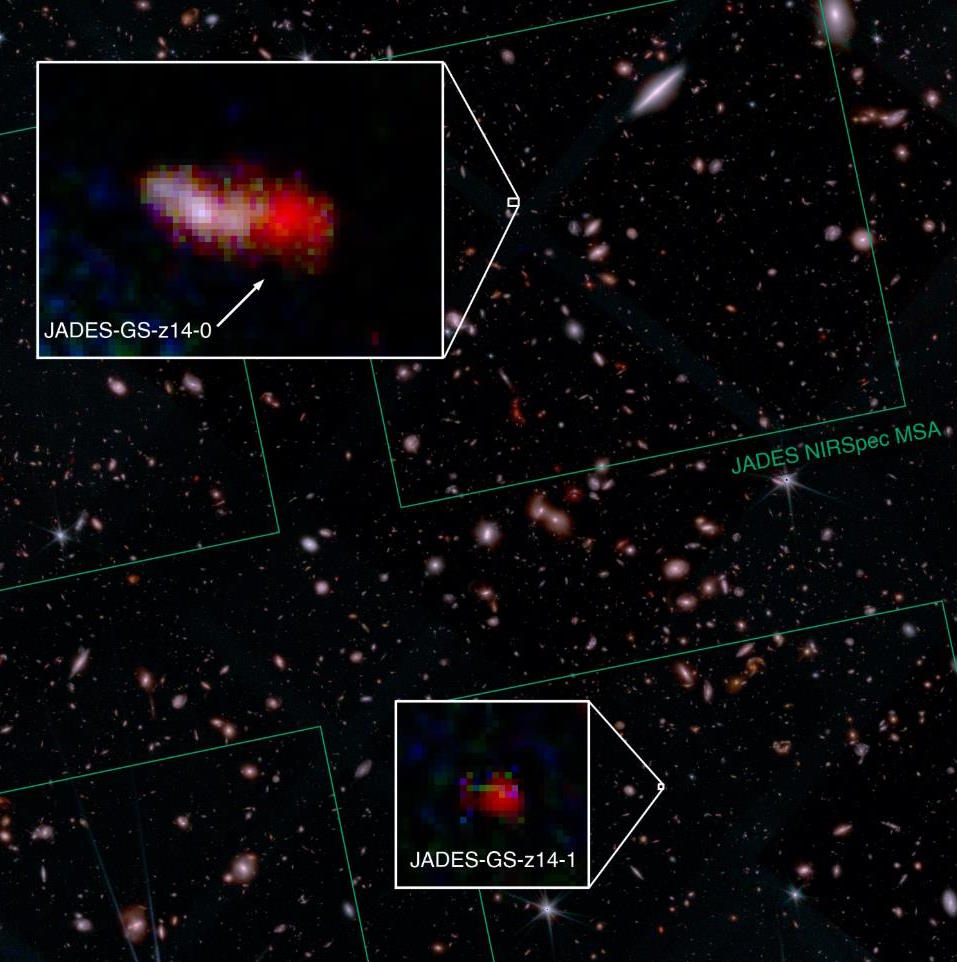
JADES-GS-z14-0, in the top inset box, is found behind (and just to the right of) a closer, brighter, bluer galaxy. It was only through the power of JWST spectroscopy with incredible resolution, capable of separating the two sources, that the nature of this formerly record-holding distant object could be determined. Its light comes to us from when the Universe was only 285-290 million years old: just 2.1% of its current age. JADES-GS-z14-1, just below it, comes from when the Universe was ~300 million years old.
Credit: S. Carniani et al. (JADES collaboration), arXiv:2405.18485, 2024

This figure shows the NIRCam (top) and NIRSpec (bottom) data for now-confirmed galaxy MoM-z14: the most distant galaxy known to date as of May 2025. Completely invisible at wavelengths of 1.5 microns and below, its light is stretched by the expansion of the Universe. Emission features of various ionized atoms can be seen in the spectrum, below, as well as the significant and strong Lyman break feature.
extended the record to its current value: 33.8 billion light-years.

This graph shows a selection of major milestones and advancements in the cosmic distance record, as it has progressed throughout history. The y-axis is in logarithmic light-years, rather than the more common redshift, to showcase how Triangulum is just 2.878 million light-years away, but the current record holder, MoM-z14, is 33.8 billion light-years distant at present.
Mostly Mute Monday tells an astronomical story in images, visuals, and no more than 200 words.