All posts tagged: marine predators

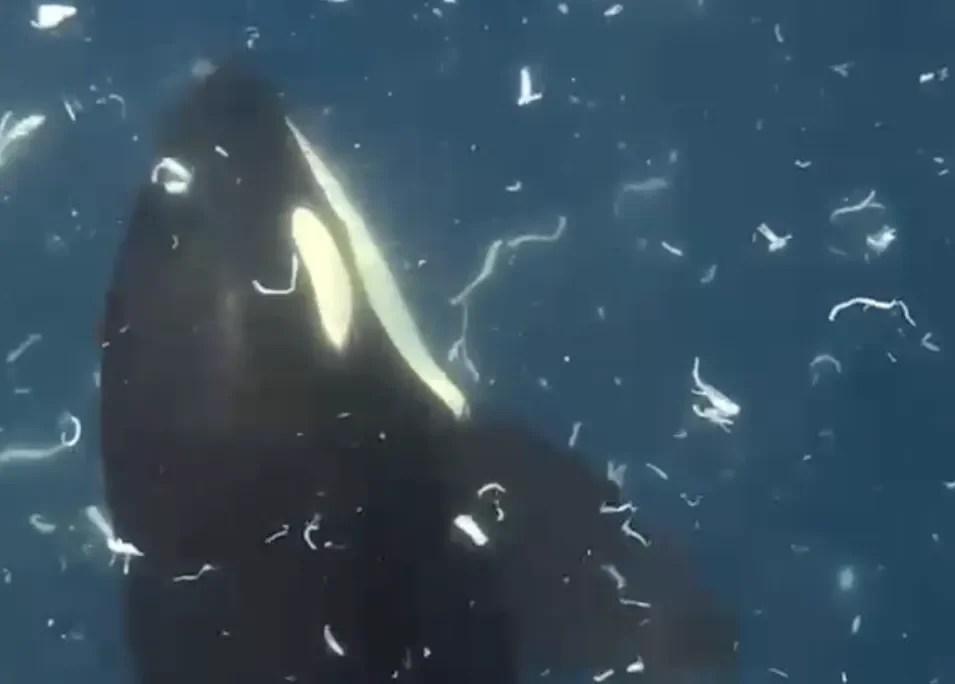
Gulf of California orcas use precision strikes to explode sunfish into thousands of pieces

Gulf of California orcas use precision strikes to explode sunfish into thousands of pieces

Orcas in the Gulf of California were recorded using a coordinated “ram-to-fragment” technique on dead sharp-tail sunfish. One orca held the carcass steady while another struck it at high speed, breaking the tissue into thousands of smaller pieces. Juvenile orcas fed on the fragments, suggesting the behavior may help younger animals eat, though it could also involve play or social learning. Two events, recorded in 2024 and 2025, suggest a newly documented prey-processing strategy that researchers now hope to study across more pods and sunfish species. Orcas in the Gulf of California Orcas in the Gulf of California have been seen using a brutal but precise way to process sharp-tail sunfish. One whale holds the carcass steady, another charges at speed, and the impact blasts the flesh into thousands of drifting pieces. The behavior, described in Frontiers in Ethology, was recorded during two separate encounters more than a year apart. Both involved coordinated ramming after the sunfish had already been killed and opened. “We document how one orca holds the sunfish and lets go just …

Tunas became large, warm-blooded predators long after the dinosaur extinction

Tunas became large, warm-blooded predators long after the dinosaur extinction

Tunas did not become large, fast and warm-blooded simply because an asteroid cleared the oceans of competing predators. Their defining traits appeared separately over tens of millions of years, complicating a familiar story about life after mass extinction. The asteroid impact 66 million years ago erased non-avian dinosaurs and many large marine predators. One long-held explanation proposed that tunas and other powerful fishes quickly expanded into the empty ecological roles. A new analysis from Yale University challenges that idea. By combining genetic evidence with fossils, researchers built the most complete time-calibrated evolutionary tree yet for Scombridae, the family that includes tunas, mackerels, bonitos and related fishes. The tree places the family’s origin near the Cretaceous-Paleogene extinction. Yet the traits that make modern tunas exceptional did not appear together or immediately afterward. Three independent origins of endothermy in Scombridae. Time-calibrated phylogeny of Scombridae estimated using a Bayesian node-dating approach, with branches coloured according to an ancestral state reconstruction of endothermy. (CREDIT: Proceedings of the Royal Society B) “Our results demonstrate the K-Pg extinction did not trigger …

Whale fossils reveal evidence of ancient shark attacks

Whale fossils reveal evidence of ancient shark attacks

A broken tooth lodged deep in bone can outlast the animal that lost it. In two whale skulls from Belgium, those fragments have done exactly that, preserving a moment of violence from roughly five million years ago. The skulls, both from the Early Pliocene, carry more than scratches. Embedded within them are pieces of shark teeth, snapped off during feeding. That detail matters. Bite marks alone can be ambiguous, but a tooth fragment ties predator and prey together with unusual clarity. Dr. Olivier Lambert of the Institute of Natural Sciences in Brussels led the analysis using CT scans, which revealed the hidden fragments without damaging the fossils. “Our knowledge of past marine mammal assemblages in the North Sea remains rather fragmentary, so any new fossil may prove informative,” he said. “In this case, the studied skulls revealed some unexpected and fascinating clues about the way these whales’ life ended.” Location of the Port of Antwerp area on a map of northern Belgium. Grey shading indicates occurrence of marine Pliocene deposits. (CREDIT: Acta Palaeontologica Polonica) A …