


Oregon is getting ready to deploy another round of fast-charging stations along the highways, and it’s a meaningful step toward making EV road trips easier across the state.
The Oregon Department of Transportation’s (ODOT) Climate Office has chosen the winners for its second round of National Electric Vehicle Infrastructure (NEVI) funding. The federally backed program is designed to build out a reliable network of public DC fast chargers along major highways.
24 new fast-charging sites are coming
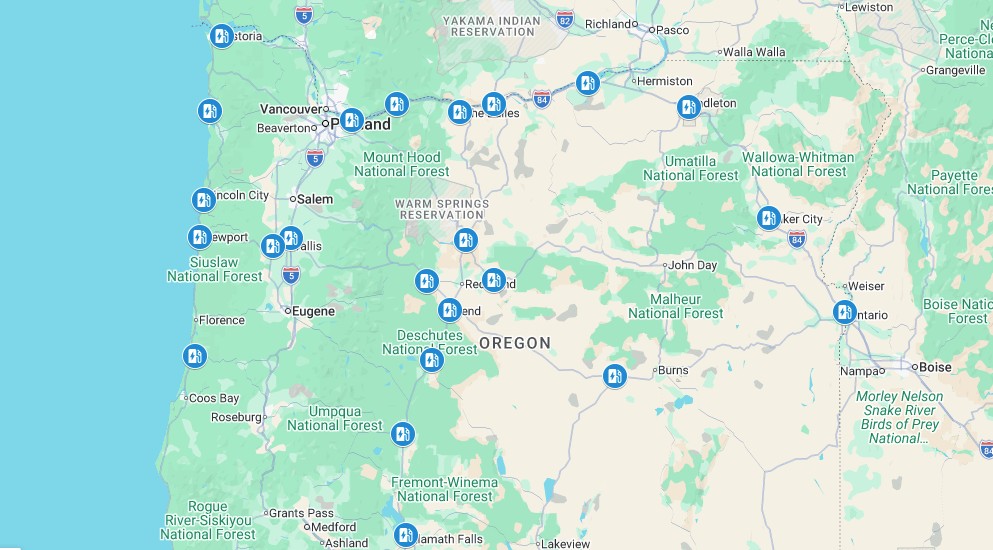
This round will fund 24 charging stations along Interstate 84 and US Highways 20, 26, 97, and 101. Each site will have at least four charging ports, with some offering up to eight, for a total of around 126 new DC fast-charging ports.
ODOT says it plans to award $16.7 million in NEVI funding to seven private charging companies, selected through a competitive process. Contracts are expected to be finalized in the coming months.
There’s no exact construction timeline yet, but several stations are expected to come online within the next 12 to 18 months.
Built for road trips – not just cities
The charging companies themselves chose the sites, and ODOT says each is located near amenities such as restrooms, food, shopping, and grocery stores along major travel routes, as required by NEVI.
A key piece of the NEVI strategy is to make charging stops normal rest stops instead of detours.
Round 3 will target rural gaps
Oregon plans to launch its third round of NEVI funding this summer, with a focus on filling rural charging gaps.
That next phase is expected to target corridors including Interstate 82, Oregon Highway 42, US Highway 95, parts of US Highway 101 south of Reedsport, US Highway 20 east of Bend, and US Highway 26 east of Prineville.
The bigger NEVI picture
The NEVI program, created by the Biden administration’s Bipartisan Infrastructure Law, aims to build a US-wide network of fast chargers across all 50 states over five years.
Oregon is set to receive $52 million through the program.
Under NEVI rules, private companies – which in this case, include Love’s, Tesla, and ChargeSmart – install, own, and maintain the stations. They’re required to provide at least 20% in matching funds and commit to maintaining each site for five years.
If everything stays on track, Oregon’s highway charging network is about to get a lot more road-trip ready.
Electrek’s Take
This is exactly what the NEVI program is supposed to do: fill in the gaps that make EV road trips stressful, not just add more chargers in cities that already have them.
Oregon’s second round is still focused on creating a seamless charging experience along major corridors, but what’s coming next is where it gets interesting. The state is clearly shifting toward rural routes – the places where a single missing charger can make an entire stretch of highway feel off-limits for EV drivers.
The timeline is still a bit fuzzy, a recurring theme with NEVI rollouts across the US. But with more than 100 new fast-charging ports planned and more rural coverage on deck, Oregon is moving in the right direction.
Read more: Ohio drops $51M on 64 new EV charging sites – here’s where they’ll go

If you’ve ever considered going solar, make it easy by finding a trusted, reliable solar installer near you that offers competitive pricing by checking out EnergySage. It has hundreds of pre-vetted solar installers competing for your business, ensuring you get high-quality solutions and save 20-30% compared to going it alone. Plus, it’s free to use, and you won’t get sales calls until you select an installer and share your phone number with them.
Your personalized solar quotes are easy to compare online, and you’ll get access to unbiased Energy Advisors to help you every step of the way. Get started here.

FTC: We use income earning auto affiliate links. More.