All posts tagged: Vegetable

I Just Learned What Capers Are Made From, And It's Not A Fruit Or A Vegetable

I Just Learned What Capers Are Made From, And It's Not A Fruit Or A Vegetable

!function(n){if(!window.cnx){window.cnx={},window.cnx.cmd=[];var t=n.createElement(‘iframe’);t.display=’none’,t.onload=function(){var n=t.contentWindow.document,c=n.createElement(‘script’);c.src=”//cd.connatix.com/connatix.player.js”,c.setAttribute(‘async’,’1′),c.setAttribute(‘type’,’text/javascript’),n.body.appendChild(c)},n.head.appendChild(t)}}(document);(new Image()).src=”https://capi.connatix.com/tr/si?token=8b034f64-513c-4987-b16f-42d6008f7feb”;cnx.cmd.push(function(){cnx({“playerId”:”8b034f64-513c-4987-b16f-42d6008f7feb”,”mediaId”:”4c2615b8-caae-4d5a-bab7-30953fac6785″}).render(“6a071976e4b098065be963d9”);}); We’ve written before at HuffPost UK about the fact that some paprika is made from a type of bell pepper called Capsicum annuum (more traditional kinds, however, usually contain Aleppo or various Hungarian varieties, among others). That made me wonder about the rest of the spices, condiments, and pickles in my cupboard.  This includes the small, briny flavour bombs, capers – which, as it turns out, are actually baby flowers. What are capers made from?  They’re made from the flower buds of the Mediterranean Capparis bush (yes, really). The small, unbloomed flowers are picked by hand, which is why they can run a little dear. Then, they’re dried, salted and/or pickled. These closed buds offer a nook-and-cranny-rich surface for salt to seep into, making the end product powerfully saline. But that’s not the only transformation that takes place: when capers are brined, salted, or pickled, they release mustard oil (glucocapparin), leading to their “intense” flavour. The University of Wisconsin-Madison added that “This enzymatic reaction leads to the formation of rutin, often seen as …

Pregnancy diet shapes children’s vegetable preferences new research reveals

Pregnancy diet shapes children’s vegetable preferences new research reveals

Get the Well Enough newsletter with Harry Bullmore for tips on living a healthier, happier and longer life Get the Well Enough email with Harry Bullmore Get the Well Enough email with Harry Bullmore Young children are more likely to react positively to the scent of vegetables if they were regularly exposed to them while still in the womb, new research has revealed. A long-running study meticulously recorded and analysed the reactions of three-year-olds to the smells of carrots and leafy kale, investigating how prenatal exposure might shape their later preferences. Experts followed up on two earlier studies involving foetuses and newborns whose mothers had consumed carrot or kale capsules during the later stages of pregnancy. The research, spearheaded by Durham University, found that three-year-olds whose mothers had taken carrot powder capsules during pregnancy displayed less negative reactions to the smell of carrots. Similarly, those whose mothers had consumed kale powder capsules while pregnant reacted more favourably to the scent of kale. These extended findings suggest that young children retain a memory of the flavour …

What’s black garlic? How a Japanese scientist reinvented the pungent vegetable

What’s black garlic? How a Japanese scientist reinvented the pungent vegetable

Sign up to IndyEat’s free newsletter for weekly recipes, foodie features and cookbook releases Get our food and drink newsletter for free Get our food and drink newsletter for free You may have seen black garlic appear more frequently in grocery stores, restaurants and online recipes over the past few years. Many chefs and food writers describe it as a unique and deeply flavored ingredient. So what is black garlic, and how is it made? I noticed a growing curiosity about black garlic firsthand while presenting my food science research at a showcase at Michigan State University. Several people asked me basic questions about black garlic, like how it is made and what sets it apart from regular garlic. The ingredient’s growing popularity reflects a broader interest in foods that offer both distinctive flavor and potential health benefits. Black garlic is not an ancient traditional food, but a recent innovation developed in Japan in the late 20th century. The process of making black garlic is often attributed to Japanese scientist Hamasuke Hamano, who spent a …

Start small, grow what you like and be realistic: how to start a vegetable garden | Well actually

Start small, grow what you like and be realistic: how to start a vegetable garden | Well actually

Maybe it’s because I’ve lived in cities my whole life, but I can’t think of anything more luxurious than popping out to your garden and eating a fresh tomato straight from the vine. How decadent to enjoy its crisp, bright flavor and the smug satisfaction that you coaxed this food into being with your own hands. But what does becoming a modern-day Demeter actually entail? What if you don’t have a yard, or even a balcony? And is it worth growing your own food when supermarkets exist? “A vegetable garden can be any size,” says Matt Mattus, senior director of horticulture at the American Horticultural Society. You don’t even need access to outside space, he says. Yes, it’s more effort than popping to the store, but there are huge benefits to growing your own veg, experts say. First, the taste and freshness. “There are no words that can describe the crunch and flavor of a fresh-from-the-garden carrot or potato,” says Mattus. There are also health benefits, says Carole Connare, editor of the Old Farmer’s Almanac …

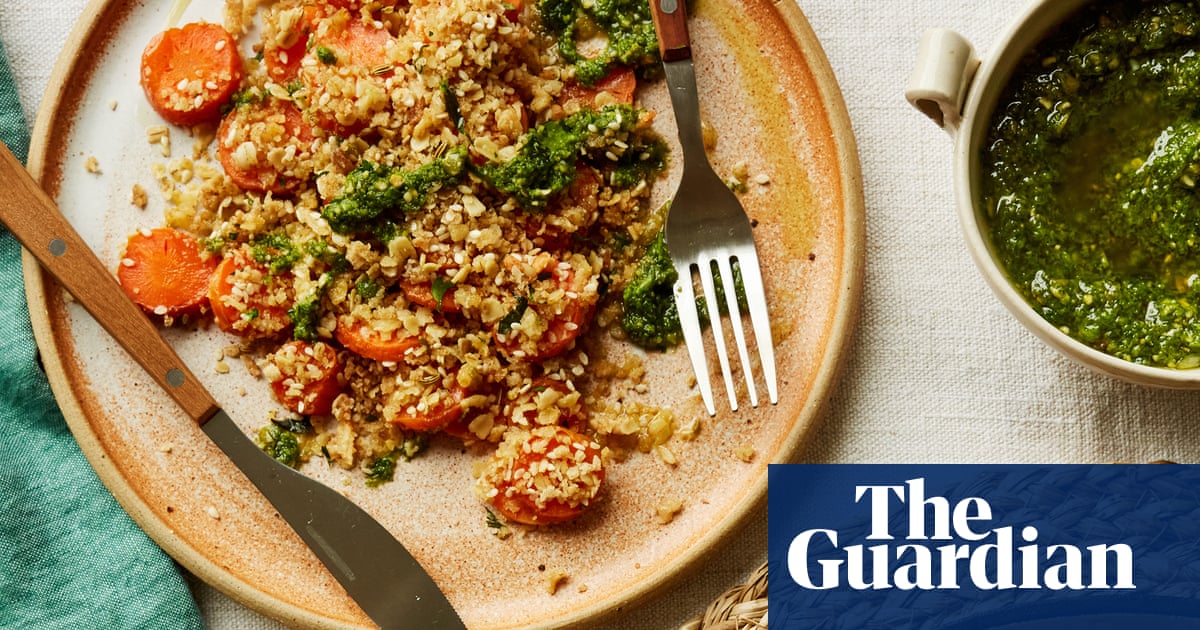
Carrot crumble and sprouting broccoli with almond butter: Chantelle Nicholson’s vegetable recipes for Easter | Food

Carrot crumble and sprouting broccoli with almond butter: Chantelle Nicholson’s vegetable recipes for Easter | Food

The intense sweetness that comes from roasting carrots should not be underestimated. And, when that’s topped with a savoury, nutty crumble, it’s a great combination. Add the wonderfully seasonal purple sprouting broccoli on the side, and it’s a luscious Easter celebration. A few low-waste tips, too: always use the parsley stalks, and try pickling the shallots in leftover gherkin brine. Trust me! And it wouldn’t be a spring recipe without our beloved wild garlic, so make the most of that while it’s about. Roast carrot crumble with wild garlic pesto Prep 20 minCook 1 hr 15 minServes 4 8 large carrots, well scrubbed2 tbsp olive oil4 garlic cloves, peeled and bashed2 bay leaves5g fine salt40g softened unsalted butter1 tbsp white or brown miso paste½ tsp fresh thyme leaves For the pesto40g pumpkin seeds30g wild garlic leaves, roughly chopped, or 2 peeled garlic cloves and 30g spinach, roughly chopped10g parsley (flat-leaf or curly), leaves and stems roughly chopped 100ml olive oil5g (1 small tsp) fine salt For the crumble50g cheddar, grated80g day-old bread, blitzed into chunky …

Local vegetable farms warn of up to 10% price hikes amid Iran war disruptions

Local vegetable farms warn of up to 10% price hikes amid Iran war disruptions

SMALL FARMS MOST EXPOSED  At SG Veg Farm in Admiralty, fertiliser costs are a growing concern.  The rooftop farm atop a HDB multi-storey carpark imports fertiliser in small batches due to space constraints, maintaining only about two months’ supply. This means it lacks the benefit of bulk pricing and remains exposed to price volatility.  “Every two months, we need to make a purchase of fertiliser. This means we are subjected to any hike in prices,” said the farm’s founder Eyleen Goh, noting that about 10 per cent of monthly operating costs is spent on fertiliser. “We looked at the prices of many different nutrients … they all increased, especially urea.”  Urea is the world’s most widely used fertiliser.  Switching to alternative sources is also “very difficult”, added Ms Goh, pointing to factors such as suitability, cost and the need to order in bulk.  The farm grows leafy greens such as spinach, basil, chye sim, kang kong and bok choy.  While fertiliser costs are beyond her control, Ms Goh is exploring ways to reduce other expenses …

Spring vegetable recipes: Asparagus, peas, tarts, quiche and galette

Spring vegetable recipes: Asparagus, peas, tarts, quiche and galette

Sign up to IndyEat’s free newsletter for weekly recipes, foodie features and cookbook releases Get our food and drink newsletter for free Get our food and drink newsletter for free Spring, when it finally arrives in the UK, doesn’t do so quietly. One minute it’s all grey skies and roots pulled from cold soil; the next, the markets are suddenly loud with green – asparagus in tidy bundles, peas still sweet from their pods, radishes with a peppery snap that feels like a wake-up call. After months of slow braises and beige comfort, cooking starts to feel lighter on its feet again. This is the moment to lean in. Not with anything too fussy, but with dishes that let the vegetables do the talking – just enough heat, just enough richness, and then out of the way. Think soft ricotta sharpened with lemon, buttery pastry that flakes rather than fights, and greens that are barely cooked, still holding onto their bite and colour. Across these recipes, the approach is simple but considered. A tart that …

Dementia Prevention: How Swapping Animal Fats For Vegetable Oils Lowers Risk

Dementia Prevention: How Swapping Animal Fats For Vegetable Oils Lowers Risk

Some research suggests that sticking to a Mediterranean diet might lower a person’s risk of dementia by as much as 23%. That involves loads of vegetables, whole grains, and olive oil. A new study, published in The American Journal of Clinical Nutrition, which followed thousands of older participants for years, has suggested that the type of oil you cook with could affect dementia risk, too. “Replacing animal fat and saturated fat with vegetable fat and monounsaturated fats could serve as a dementia prevention strategy,” it reads. Why might that be? The researchers looked at the data from just under 6,000 participants who had an average age of 68 at the start of the study. None had dementia in the beginning. The study authors asked participants to fill in surveys about the food they most regularly ate. That included the oils they cooked with, but they also counted oils already present in premade food they consumed. Scientists split the oils they consumed into animal and vegetable fats, and also marked which were monounsaturated and polyunsaturated fats …