


During a global moment where oil prices are spiking tremendously, a movement to increase gas taxes is brewing in Australia. And if it does succeed, it could provide a template that could help other countries not only fund their own prosperity, but reduce the tremendous damage done by fossil fuels.
At issue are Australia’s exports of petroleum gas, largely in the form of liquified methane.
While Australia is a generally wealthy nation, its economy is less complex than many other advanced nations, and relies heavily on extraction of natural resources. Australia’s export value is concentrated in raw material exports, rather than complex manufacturing.
Much of Australia’s wealth comes from mining, but as you can see on the charts below, petroleum products make up a big chunk as well. Australia is in fact the third-largest global exporter of petroleum gas behind US and Norway, and its exports mainly go to Japan, China, and Southeast Asian countries.
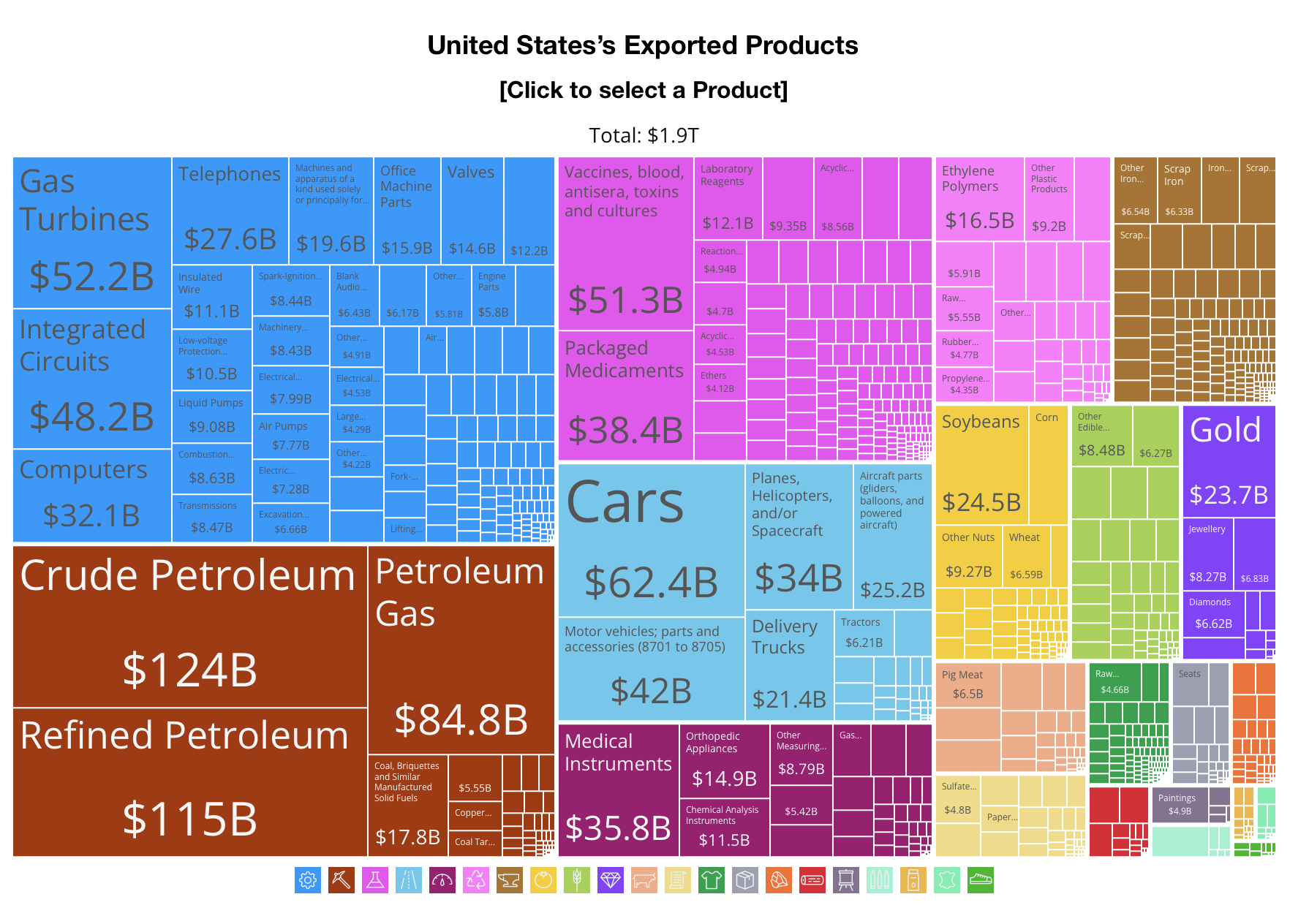
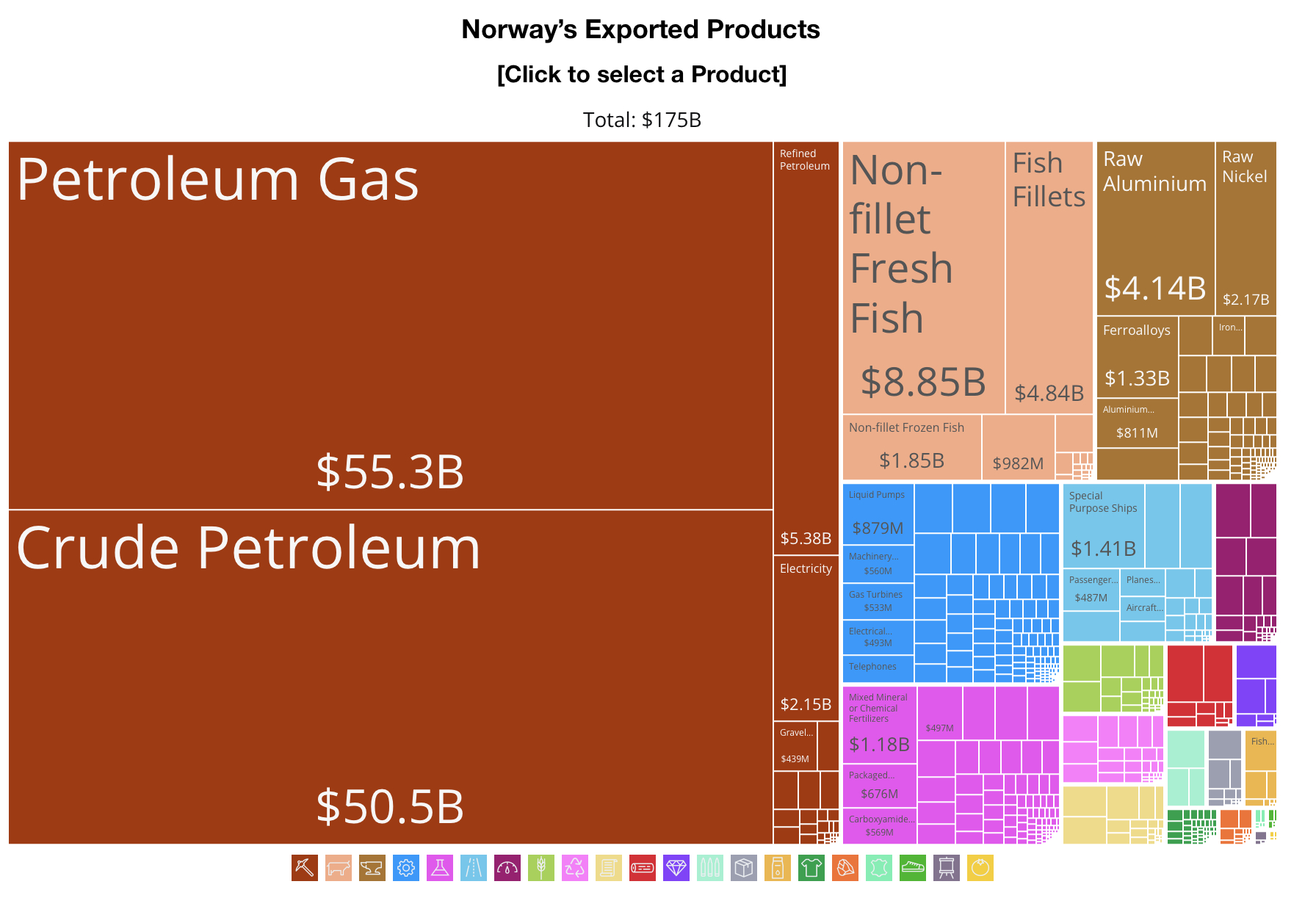
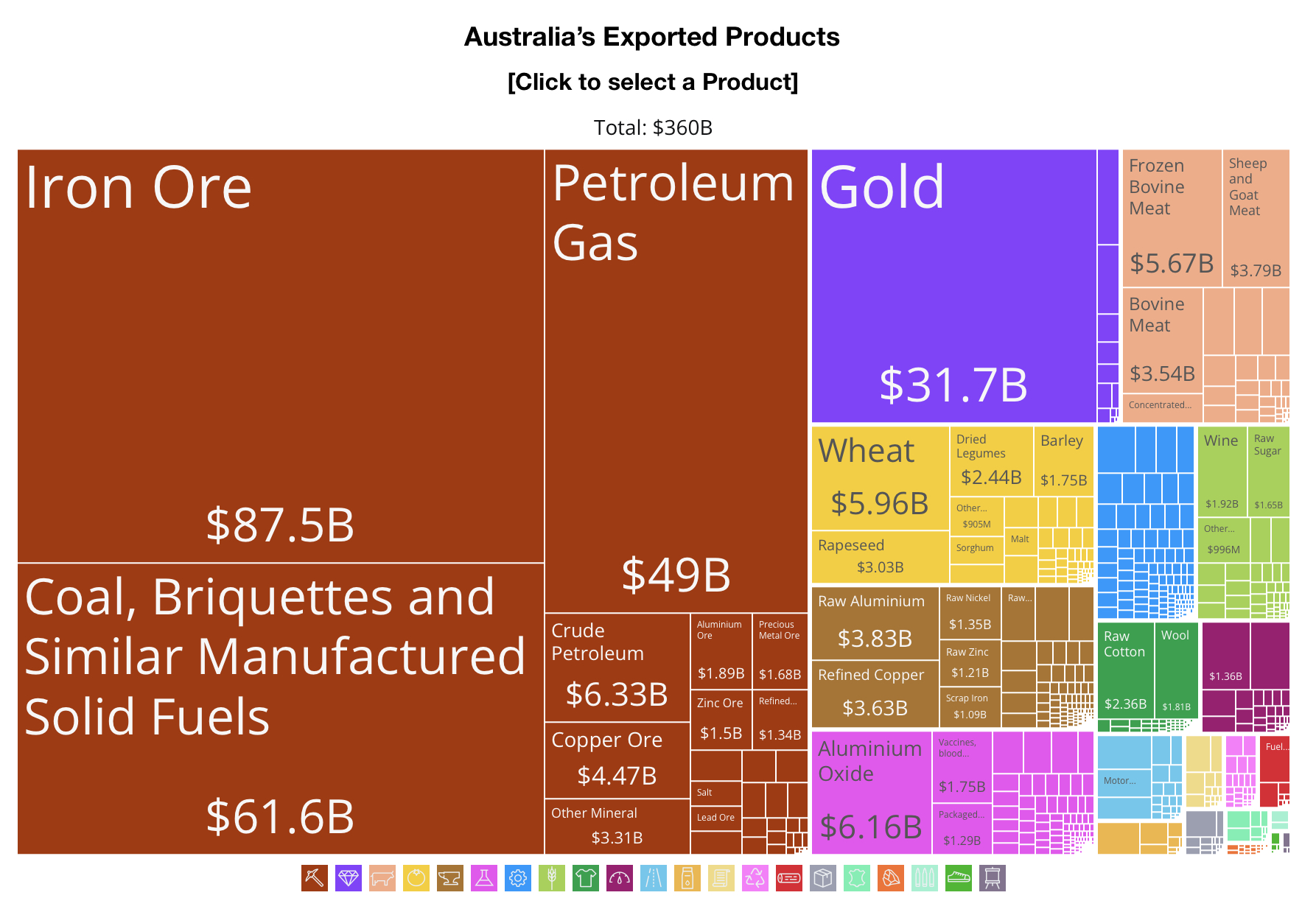
Australia’s politics have also long been dominated by elites associated with extractive industry, or with climate denial, which dominates Australian media. This has tended towards increasing Australia’s reliance on these industries, rather than helping the nation diversify its economy.
But as one might expect in a country where politics are dominated by elites in extractive industry, the benefits from the extraction of those natural resources have not been distributed to the Australians who the resources rightly should belong to. Instead, the aforementioned elites, and foreign oil companies as well, have taken those profits while giving very little back to the people they are taking them from.
Other countries gain more benefit from their resources
When comparing to other countries with similar levels of gas exports as Australia – Norway in 2nd place and Qatar in 4th place – Australia’s public revenue from these resources is dwarfed by each. Norway levies significant taxes on its oil & gas sector, which it uses to pay for its massive sovereign wealth fund, the largest in the world. And Qatar collects five times as much money for its public coffers than Australia does, despite exporting less gas than the land down under.
Australia used to raise significant money from something called a “Petroleum Resources Rent Tax,” intended to function as a profits tax. But oil companies have figured out ways to get around it, and as oil company profits have shot up, PRRT taxes paid have remained stable or fallen. Australian gas export value has increased to nearly $50 billion yearly, but the PRRT only brings in around $2 billion per year for Australians – even after some tweaks to the rules, which are falling short of expectations.
Oil & gas companies have been called “systemic nonpayers of tax” by the Australian Tax Office.
These facts are at the center of a recent movement to get oil companies to pay their fair share – and the idea is to do so by levying a tax on gas, specifically on gas exports, at a proposed 25% rate.
The current push for this tax originated from the Australian Council of Trade Unions (ACTU), Australia’s largest trade union coalition. A main tenet of the ACTU is to ensure the use of Australian resources to establish equitable living standards for Australians. But the campaign has since gained broad support, largely through social media.
A YouTuber is one of the main advocates for a gas tax
One of the faces of this movement has been Konrad Benjamin, a former economics teacher who now runs a YouTube and TikTok Channel called Punter’s Politics (“punter” is Australian slang that originally referred to gambling but now means something along the lines of “average citizen”).
He’s done a series of videos highlighting the lack of public contribution made by oil & gas companies operating in Australia, many of which are foreign-owned and pay little to no taxes on the hundreds of billions of dollars of export value that Australia gives them “for free.”
The videos have included stunts like buying billboards showing oil company tax rates, distributing stickers, and giving out free beer to highlight that Australians pay more in beer taxes than foreign-owned oil companies pay on the PRRT.
One common angle of attack used by Benjamin has been the fact that oil & gas companies pay an overall lower tax rate than the public – such as schoolteachers, his former job, which collectively pay twice as much tax as oil companies do.
Now, one may suggest that it is naive to think that internet virality equates to real policy change, and they’d be right – if this issue stopped with a single Youtube channel.
But it’s not just YouTube – Australians are fed up
The issue hasn’t just stopped at “clicktivism” and millions of social media views. Benjamin’s channel has raised nearly $200,000 and even crowdfunded a lobbyist to bring this issue to the Australian government.
Mainstream Australian news picked up on the movement, interviewing Benjamin during his “free beer” stunt (see video above).
All of this led the Australian Senate to field an inquiry into the situation, where Benjamin testified alongside Richard Denniss, the co-CEO of the Australia Institute, a public interest think tank. Their work is cited by many advocates for the gas tax.
The Australia Institute has produced over the years a series of research reports highlighting this issue, suggesting that Australia is missing out on $350 million in revenue per week and having its own gas and electricity prices increased due to this giveaway of its natural resources.
While the ACTU started this current gas tax push, the Australia Institute has been calling for gas tax reform since at least 2013.
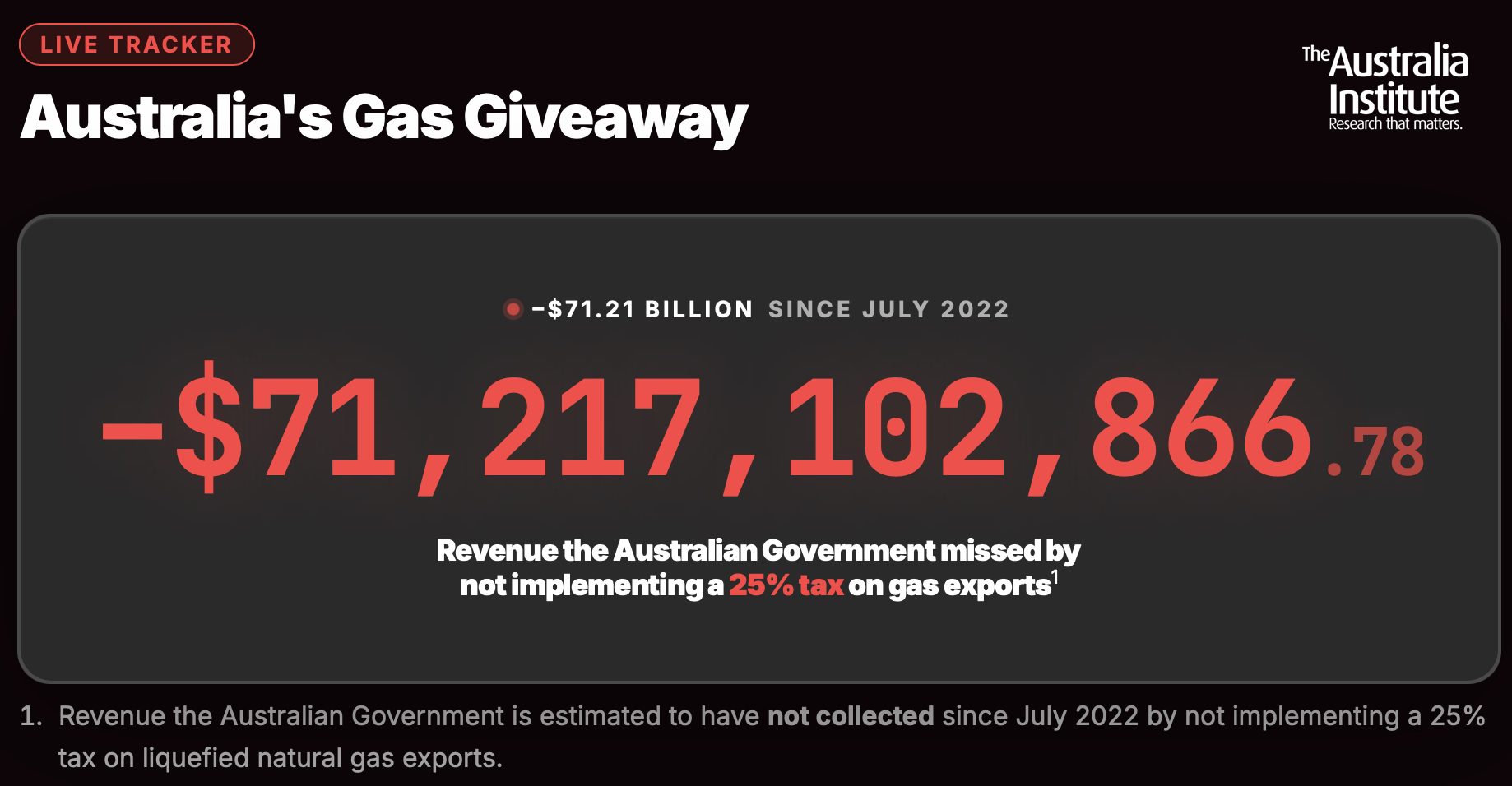
This money could pay for vital services for Australians, like by funding free dental coverage or childcare, or make vocational education free, or filling in cuts in Australia’s disability services.
The movement has found some notable allies in the Australian government, such as David Pocock, an independent MP who has advocated for the tax. Even former Australian Treasury Secretary Ken Henry, who worked with both center-right Liberal and center-left Labor governments, has joined the fray in support of the gas tax.
Just do it, in the national interest, just do it. And stop the crap that the Australian public have put up with for decades now in respect of the taxation of Australia’s finite resources.
-Ken Henry, former Treasury Secretary, in comments to the Australian Senate
A recent poll showed that 57% of Australian voters supported the gas export tax, and only 12% opposed it, though the remainder were unsure about the issue. That’s despite a multimillion-dollar campaign by oil to convince the public on their side, much more money than advocates of the plan have spent.
PM Albanese opposes the gas tax at a dangerous time
But unfortunately, Prime Minister Anthony Albanese, who has otherwise been reasonably good on issues related to the environment, electrification, and renewable energy, has declined to advance these popular calls for a gas tax in Australia’s budget, which was just announced early this month.
He called the campaign for this tax “dishonest” and said advocates were not being “fair dinkum” – though he didn’t have the same smoke for his recent move to subsidize polluting petrol, causing more of the sort of climate change that burns Australia to a crisp every summer and costs it billions.

Albanese opposes this popular policy at a dangerous time politically, as challenger parties are rising in the polls against him. A gas tax is supported by the Green Party which has called to tax gas exports for a decade, for obvious reasons, but media has widely (though perhaps inaccurately) reported that Australia’s far-right One Nation racist/nativist party even surprisingly says it supports taxing gas.
In the case of One Nation, there is evidence that the support is perhaps dishonest. The policy, which many have wrongly called “Norway-Style”, includes many carveouts like grandfathering old projects, was crafted with the help of the oil & gas industry, was announced at an oil producers conference, and comes from a party that denies the science of climate change and is heavily funded by fossil fuel magnates. However, the party’s voters do support a gas tax, so it had to offer something that sounds like one.
Which brings up a good point: Even though this policy is likely a good thing for the climate, you don’t need to understand climate science to support it, as it brings in money for the Australian public anyway. As Richard Denniss of the Australia Institute told us, “Making the gas export industry pay for their gas is good economics and good politics.”
Albanese’s opposition is also puzzling given that the campaign started with a campaign by labor unions. What’s Albanese’s party called again? That’s right, “Labor.” And the party has historically had high support from labor unions, and taken pro-labor positions. The proposal is popular across the political spectrum, including with Labor voters.
The next election is some ways away, but Albanese’s unpopular stance against commonsense policy could harm him politically, and could help to feed the reactionary elements in Australian society that seek to impose ignorant, racist fascism under the false guise of a pro-Australian populist movement (but surely that could never happen in a developed Anglophone country… right?). And the fossil companies aren’t funding Labor, anyway – they’re funding the opposition, including One Nation.
The PM has said that ‘now isn’t the time’ for a gas export tax, but every week we delay costs Australia $350 million. The ACTU is affiliated with the Labor party and has a strong track record of influencing Labor’s policy. Labor back bench MPs have spoken loudly in favour of the idea and a number of ministers have been cautious not to criticise the idea too loudly. Whether the PM is defined by introducing the most popular tax reform in Australian history or by refusing to implement the most popular tax reform in Australisn history is yet to be determined, but the pressure on him from the public is enormous, as is the pressure on him from the foreign-owned gas industry, which, understandably, likes getting most of its gas for free.
-Dr Richard Denniss, Co-CEO, Australia Institute
Albanese’s opposition seems focused on potential strain on relationships with Australia’s trading partners in Asia, making those countries pay more for gas during the global fuel crisis brought on by the US war on Iran. Japan – whose gas company INPEX has paid no Australian tax in a decade (meaning Japan has actually raised more tax revenue on Australian gas than Australia has) – said the gas tax would be a “bad surprise.”
But advocates for the tax point out that global oil prices are not set by Australia but rather by the global market, and prices will be set in accordance to that market, not directly due to Australian policy.
…….unless.
Other countries could learn this lesson, making fossil fuel prices more realistic
And here’s where we get into the hopeful part of my own commentary.
Some have said that this would not increase gas prices for the Australian consumer, or even for the Japanese consumer, due to oil being a global commodity whose prices are set by demand, not by a single country’s export tariffs.
But, if this is successful – and I argue that it ought to be – other countries could learn from a movement like this. It’s an objective fact that oil companies pay far too little tax globally, and every economist agrees on this.
And in cases where natural resources aren’t nationalized and extractive industry has low tax rates and high profits from activities that are destroying the planet, it’s very easy to make the case that these companies are stealing resources that should either be left where they are or, if they are extracted, should be used to benefit the public good.
Some countries have rightly imposed taxes against the massive amounts of pollution that carbon emitters put out, which causes millions of global deaths and trillions in global economic damages per year. But other countries have found it less possible to do so – see the Albanese government’s recent move to decrease petrol taxes, a populist move that is not actually in the interest of the country or the planet, as that oil still causes just as much environmental and health damage after taxes are decreased.
The gas export tax offers another method that could actually increase a politician’s public support, given the massive amount of support the proposal currently has among the Australian populace. Taxing companies that everyone knows are evil and rich, and who are getting free use of resources that should belong to everyone, and using that money to pay for public services that make people’s lives better, is a huge win in basically every way (other than campaign financing or potential post-public-office lobbying career opportunities for the government official in question, anyhow).
And in contrast to supporters’ claim that an Australian gas export tax wouldn’t do much to change prices in global energy markets, if every country recognized the benefits that could come from a tax like this, then we probably would start to see higher global fossil fuel prices, leading to lower margins for the oil & gas companies that make a business of killing us, and a more palatable economic situation for superior renewable energy which is already catching on despite fossil fuels’ massive subsidy advantage.
Further, oil companies threaten that the gas tax would discourage investment in exploration and extraction in Australia (never mind that it hasn’t stopped them in Qatar or Norway)… and, well, reducing extraction sounds pretty good to me considering our global objective need to keep it in the ground.
So by any reasonable, big picture calculation, this would be an unequivocally good thing for the planet and everything that lives on it, and for the general Australian public – so I’m with the punters on this one.
Charge your electric vehicle at home using rooftop solar panels. Find a reliable and competitively priced solar installer near you on EnergySage, for free. They have pre-vetted installers competing for your business, ensuring high-quality solutions and 20-30% savings. It’s free, with no sales calls until you choose an installer. Compare personalized solar quotes online and receive guidance from unbiased Energy Advisers. Get started here. – ad*

FTC: We use income earning auto affiliate links. More.