


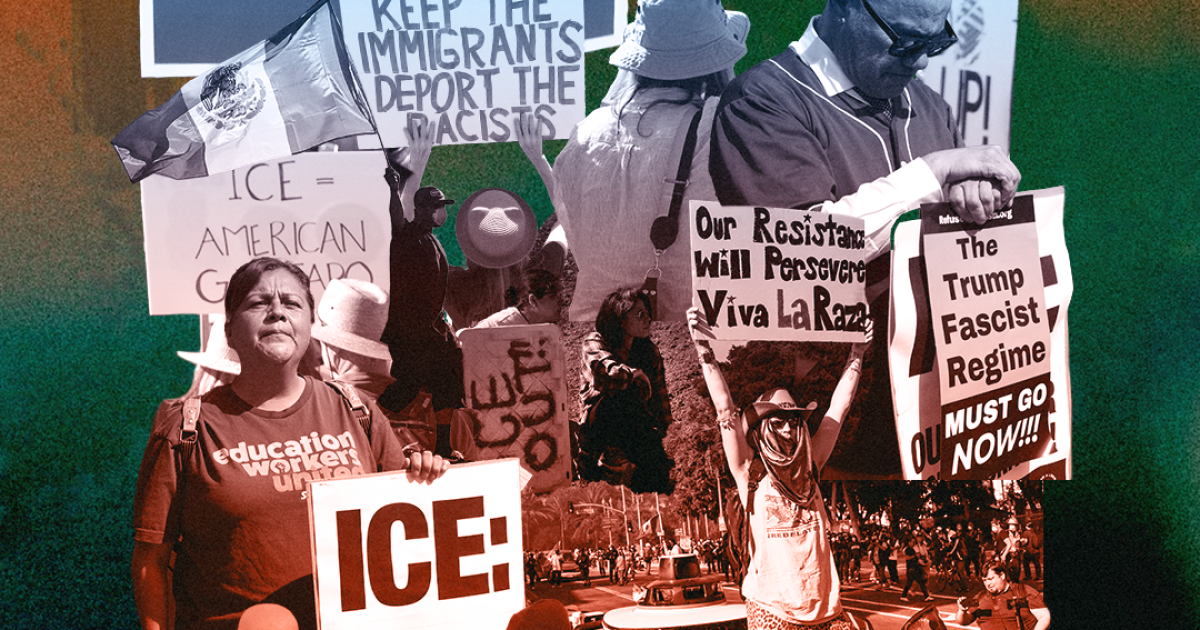
A year ago, I wrote in this very newsletter about how Immigration and Customs Enforcement officers tried to execute two raids in San Diego, but came face-to-face with San Diegans who fought back.
That was merely the beginning of the summer of ICE across the country, but specifically Southern California.
The day that newsletter came out, ICE conducted two raids in Los Angeles — one in the Garment District and another at a Home Depot in Westlake. As the enforcement actions took place, onlookers clashed with federal officials. Protesters were assaulted and injured as agents rained down gas and less-than-lethal rounds on crowds.
This marked the first day of massive protests against the many raids that popped up in and around L.A. that continued for over a month. Thousands of people were detained by ICE in the L.A. area last summer, most of whom had no criminal record.
And which section of the population — as data have shown — was and continues to be the hardest-hit in the region? The Latino community.
As we all know by now, the events in L.A. merely set the stage for what was to happen throughout the country.
In September, the Department of Homeland Security launched “Operation Midway Blitz” in the greater Chicago area. Much of the immigration enforcement activity was concentrated in the predominantly Latino neighborhoods of Little Village, Pilsen and Humboldt Park, deeply impacting those communities. Homeland Security carried out “Operation Charlotte’s Web” in November after claiming that North Carolina was overrun by criminal undocumented immigrants because of “sanctuary politicians.” Latinos also received the brunt of the enforcement in Charlotte.
Then there was the mess and tragedy of the January 2026 Minneapolis raids, in which ICE agents killed U.S citizens Renee Good and Alex Pretti. It also resulted in the stirring image of 5-year-old Liam Conejo Ramos — wearing a bunny beanie and carrying a Spider-Man backpack — being detained by an ICE agent.
The onslaught hasn’t stopped.
Latino journalists have been detained by ICE in Atlanta and Nashville. In Virginia 11,000 people have been arrested by ICE since the start of 2025. Thousands of others were apprehended in Washington’s three largest counties, which have the largest Latino populations in the state. In the L.A. area alone, ICE arrests tripled in 2025 to over 14,000.
ICE detention centers across the country have become points of contention among immigrant activists, with a myriad of reports exposing the inhumane conditions that detainees have been forced to live in.
Over the weekend, protesters clashed with law enforcement outside of the Delaney Hall detention center in Newark, N.J. The demonstrations began after detainees launched a hunger strike over poor living conditions at the 1,000-bed facility. At California’s Adelanto detention center — where four detainees have died in recent months — 40 detainees have also engaged in a hunger strike to bring attention to conditions at the facility, including mold, unsafe drinking water and a lack of medical care.
Homeland Security has repeatedly denied that conditions at any of its facilities are substandard or hazardous.
The effects of the raids in L.A. are still palpable. Anecdotally, I know individuals who refuse to venture out to certain parts of the city due to fear of apprehension by ICE. The Times recently documented how fear still looms large over Latino shopping centers throughout the city since the ICE raids ramped up last year, including at the famed Santee Alley.
All of this may have you believe that ICE and Homeland Security are winning in their crusade against the terrifying specter of the villainous immigrant. But a closer look reveals that’s not so much the case.
Last month the New York Times reported that President Trump’s proudly touted Florida detention center known as “Alligator Alcatraz” will close by the end of June. The facility’s opening was plagued by human rights and environmental lawsuits. Rep. Maxwell Frost (D-Fla.) spoke with The Times last year about the conditions at the center after he took a tour of it. He saw dozens of detainees crammed into cages and forced to share only three toilets.
“From a human point of view, it really hurt my heart to be there and see all these Latino men — Black and brown men in these cages chanting, ‘Libertad!’” he recalled. “People [were] asking me to contact their families to tell them they’re OK.”
This closure means that Florida Gov. Ron DeSantis’ administration and DHS wasted nearly $1 billion on the project, millions of which was put forth by taxpayers.
ICE raids have also been a thorn in the side of Trump’s popularity. The president focused a large portion of his 2024 reelection campaign promising to rule with an iron fist on the subject. An overwhelming majority of his voter base named it as their top political priority during election season.
According to a Reuters/Ipsos poll, the disapproval rate of Trump’s handling of immigration went from 36% in January 2025 to 55% by February 2026. This drop included a 10 percentage point dip in support from men, who have historically backed Trump’s policies at a higher rate. Overall, Trump’s disapproval rating hit an all-time high this week after an Economist/YouGov poll found that 61% of adults from all political backgrounds disapproved of how he’s handled his job.
Most notably, Trump has lost support among Latinos who voted for him in 2024. A Pew Research Center survey found that 66% of Latino Trump voters approve of the president’s job performance 16 months into his second term. That is a drop of 27 percentage points from where the group stood in February 2025. The trend also mirrors the downward trajectory of the president’s support from the wider Latino community, slipping from 36% to 22%.
A lack of faith in the president’s ability to make good decisions about immigration played a key role for those who are retreating from their approval of Trump’s performance. These findings come less than two years after Trump overperformed with Latino voters nationwide during the 2024 election.
The raids also exposed Trump on the economic front. New research from Trump’s alma mater, the University of Pennsylvania, found that the ICE raids have had long-lasting and far-reaching negative effect on the nation’s economy. This is likely due to the fact Latinos have proven spending power in this country. A UCLA study showed that the U.S. Latino gross domestic product reached $4.4 trillion in 2024, the raids are likely to affect that number for 2025. The surge in enforcement also cost the economy upward of 660,000 jobs nationwide. Those who have soured on Trump in recent jobs have also pointed to the economy and employment numbers as key factors.
One other avenue in which anti-immigrant and anti-Latino sentiment has faced a series of roadblocks is in the courts
In April, Trump’s Department of Justice went to the Supreme Court to fight for a retconning of the 14th Amendment’s birthright citizenship clause that would severely limit who would be considered a citizen. Trump made a big show of being the first sitting president to attend a Supreme Court hearing, but left with egg on his face after the justices openly scoffed at the Justice Department’s ridiculous arguments. The court has yet to rule on the case, but all signs point to the judges siding against Trump’s wishes.
Across the country federal judges have ruled in over 10,000 cases that people had been illegally detained by ICE agents. Earlier this year, my colleagues James Queally and Brittny Mejia wrote about how Homeland Security and Border Patrol had lost several court cases in which agents claimed they were assaulted in cities such as L.A., Chicago and Minneapolis.
These huge losses don’t project the vibes of a winner.
Obviously, people are still hurting and families have been irreparably fractured — I don’t want to minimize that in any way.
But don’t let all the chaos and hubbub of the Trump administration fool you, the narrative has slipped from its grasp and it’s flailing now. Hell, they can barely even secure funding for these raids nowadays.
ICE is not winning the war it waged to prove that immigrants are the bogeymen of this country. I have a feeling that this fall’s midterm elections will highlight the nation’s rebuke of policies of hate and division.
All we can hope is if power shifts from red to blue, that Democrats finally move away from their performative allyship, develop a backbone and stand up to the tyranny we are facing.
(Jackie Rivera / For The Times; Martina Ibáñez-Baldor / Los Angeles Times)
Movie recommendation of the week
As one of our New Year’s resolutions this year, my fiancée and I decided to embark on the Herculean task of watching a movie a day. It may not necessarily sound that difficult, but many are the days where it hits 9 p.m. and we’ve got to flip on a flick even though the only thing I want to do is sleep. Woe is me indeed.
Thanks to this journey I’ve watched a lot of features that I would have never otherwise sought out — both positively and negatively.
Some nights we watch a lazily thrown together film from the ‘50s on a streaming service. Other nights we watch amazing movies like Akira Kurosawa’s epic “Ran” or the Cuban masterpiece “I Am Cuba.”
In this section, I’ll try to highlight Latino movies as much as possible.
This week, I’ll recommend a film that features a Latina star — the recently released Boots Riley flick “I Love Boosters.” It stars Keke Palmer, Naomi Ackie, Poppy Liu, Eiza González and Taylour Paige. The film is both ideologically and visually radical, as well as sharply funny. There is a psychedelic tint to the entire project that might not work for everyone, but gives it a frenetic energy that ties in nicely to the themes of the film.

Palmer plays the leader of a group of shoplifters who nab clothes from high-end retailers. The crew of thieves ultimately get involved in a scheme to get back at a villainous fashion designer played by Demi Moore.
The “True Jackson, VP” star shines in the role as she gets to show off her comedic chops as well as her ability to portray sincerity. Ackie excels in the role of a somewhat dopey but strong-willed friend to Palmer’s character. In my estimation, González gives one of the more bizarre yet compelling performances as a perpetually stoned and politically aggravated retail worker with otherworldly knowledge of emerging technologies.
For those who enjoyed Riley’s debut film, “Sorry to Bother You,” his latest effort is sure to delight. The director’s dedication to resisting norms and pushing forth a progressive agenda through his art is impressive.
The revolution might not be televised, but it is currently screening at a theater near you.
Stories we read this week that we think you should read
Unless otherwise noted, stories below were published by the Los Angeles Times.